
The government cuts a tax. The price at checkout doesn’t move. What happened to your discount?
In the latest WISU issue, our colleague Prof. Dr. Florian Bartholomae (Munich Business School) tackles a question that keeps resurfacing in political debates: when the state lowers a tax, does the saving actually reach consumers or does it quietly disappear into someone else’s margin?
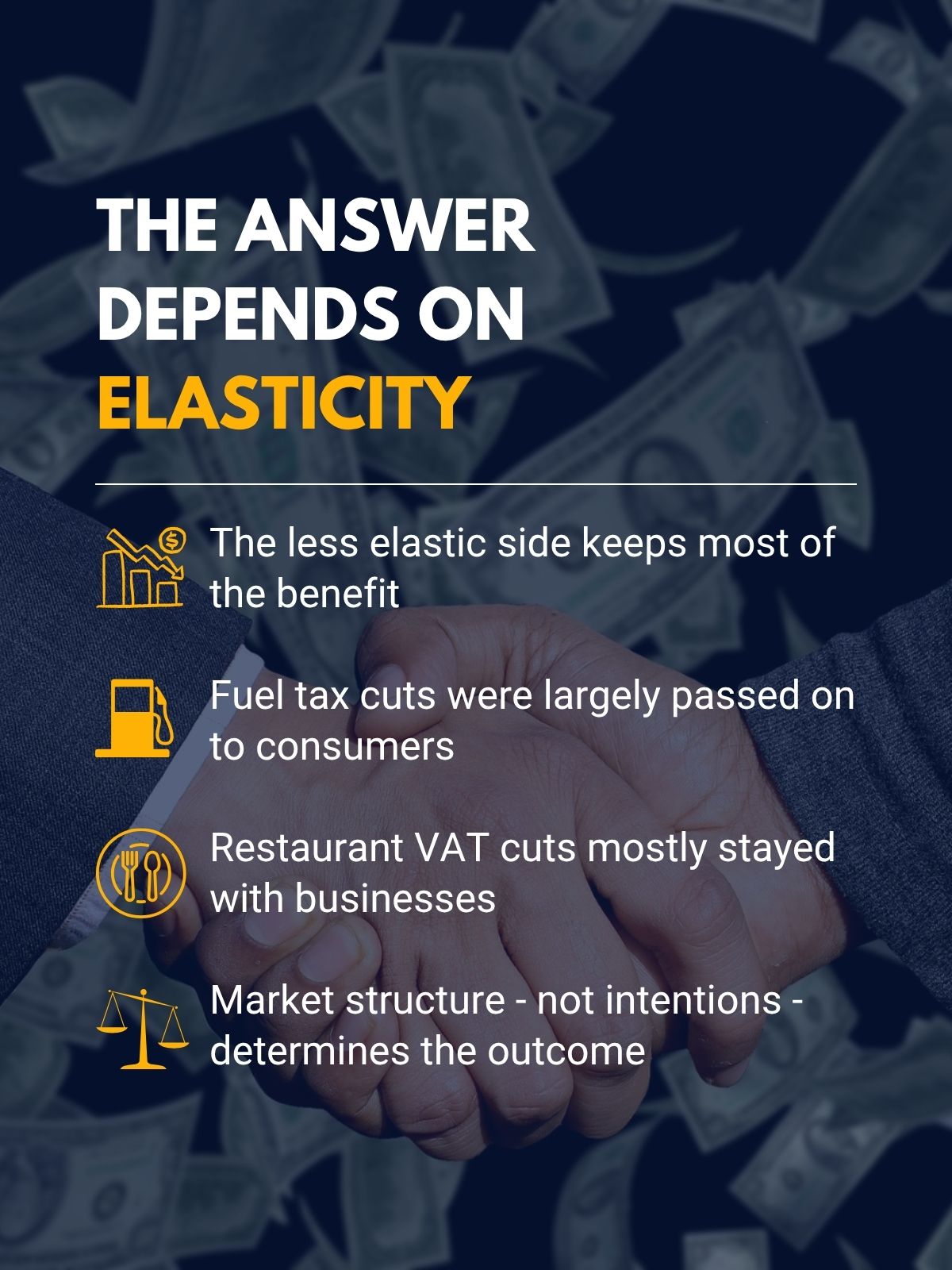
The textbook answer sounds almost too simple: it doesn’t matter who is legally required to pay the tax. What matters is elasticity: how easily each side of the market can walk away from a price change. Whichever side is less able to adjust (the less elastic one) ends up bearing most of the burden, or in the case of a tax cut, keeping most of the benefit.
Prof. Bartholomae puts this to the test with two real, recent German policy interventions:

- The fuel tax rebate from 2022: Drivers can barely change their driving habits when fuel prices shift. Demand is stubbornly inelastic. Result: real-world data show close to 100% of the discount on diesel, and around 85% on premium gasoline, was passed straight through to consumers at the pump.
- The restaurant VAT cut from 2026: Here the mechanism flips. Demand for eating out is relatively elastic. People simply eat at home more if prices rise. But supply is the inelastic side: restaurants are boxed in by fixed seating, staff, and rent. So when VAT dropped from 19% back to 7% in 2026, menu prices barely moved. A roughly 10% price cut was mathematically possible. Almost none of it showed up on the bill.
Same policy tool. Same government. Wildly different outcomes, because the underlying market structure, not political intent, decides who actually benefits.
The broader point Prof. Bartholomae makes is a sharp one: the public debate about corporate “greed” when tax relief doesn’t reach consumers usually misses the mechanism entirely. It’s rarely about goodwill or fairness. It’s about which side of the market can least afford to walk away. Relief packages that ignore elasticity risk missing their own distributional goals by design, not by accident.
A great reminder that behind every “we’re cutting taxes to help you” headline sits a market structure quietly deciding who really gets the money.
Curious? Elasticities are covered in the BA course “Microeconomics” right in the first semester. Congratulations to Prof. Dr. Florian Bartholomae on this publication!