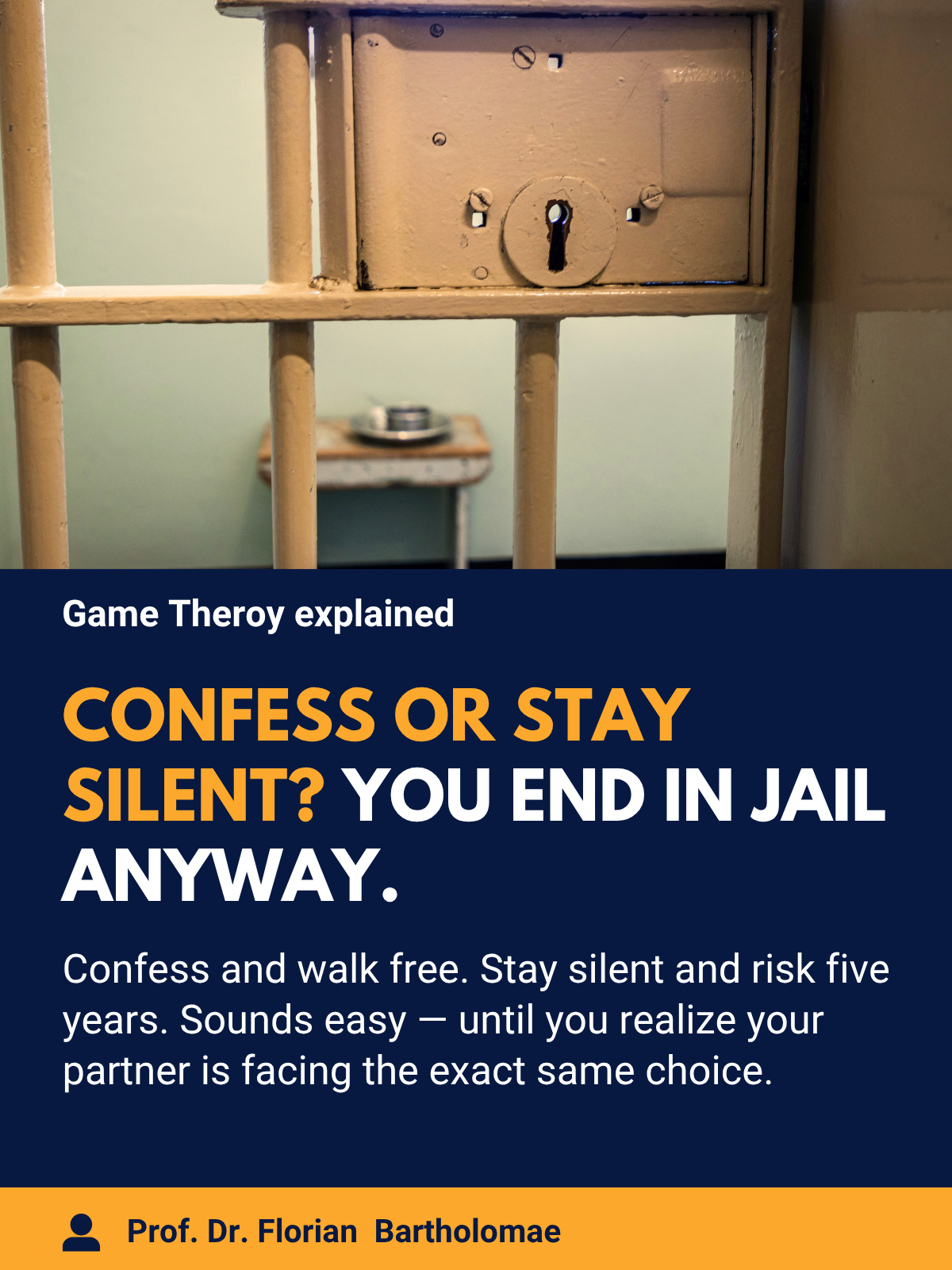

Two suspects. Two interrogation rooms. One decision that will define game theory forever.
Here’s the setup: You and an accomplice are arrested. No communication allowed. Prosecutors offer you both the same deal, testify against the other, and you walk free while they take the fall. Stay silent, and you both get off lightly on a minor charge… unless the other one talks first.
What would you do?
In the latest issue of WISU, our colleague Prof. Dr. Florian Bartholomae (Munich Business School) breaks down the Prisoner’s Dilemma, arguably the most famous thought experiment in economics and why it still matters far beyond the interrogation room.
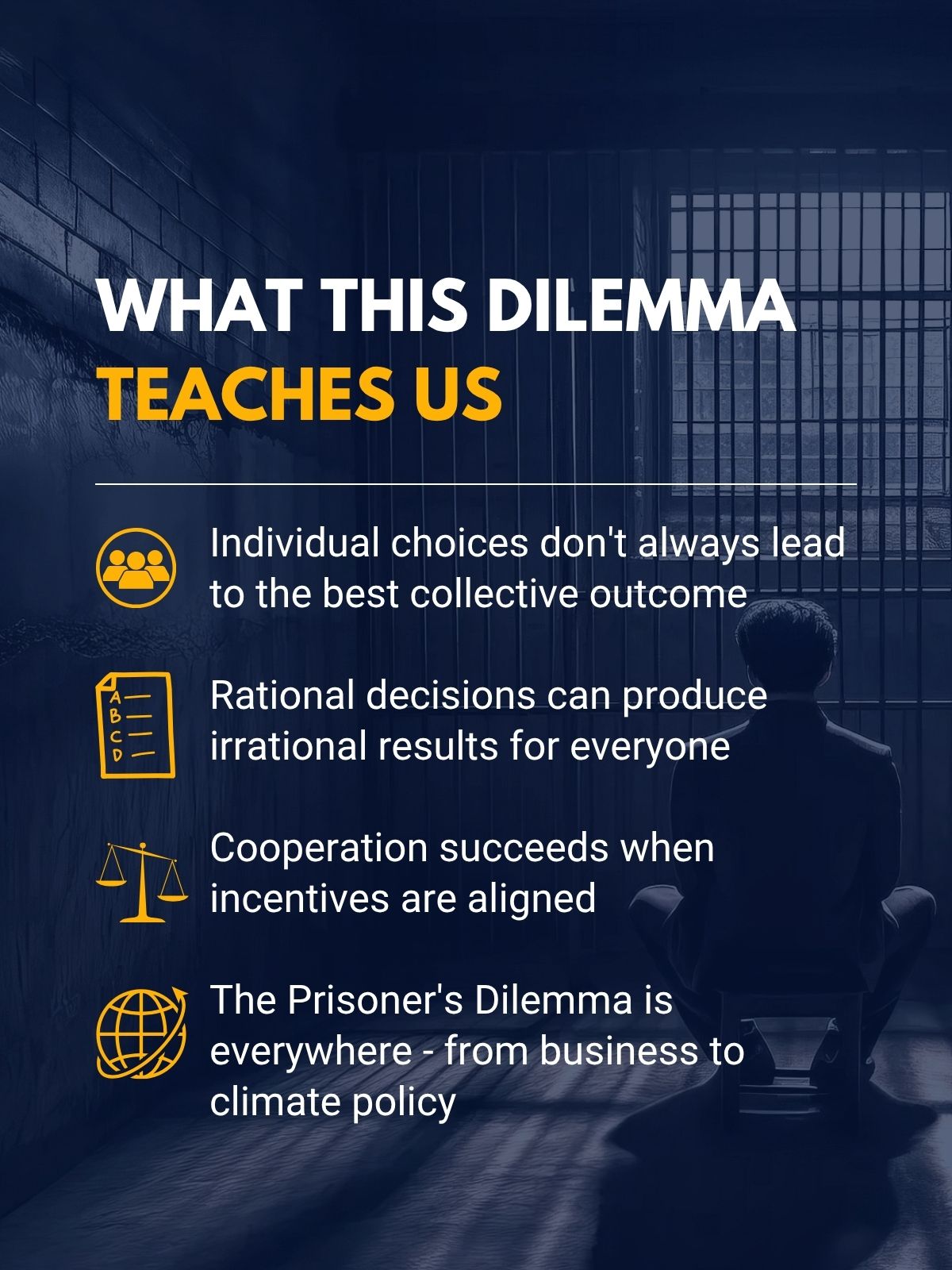
The uncomfortable truth: Even when both players act perfectly rationally, they end up locked into the worst collective outcome. Not because anyone is greedy, irrational, or “bad”, but because the incentive structure makes betrayal the smarter individual move, every single time.
Prof. Bartholomae walks through the logic (dominant strategies, Nash equilibrium, why “just talking it out” beforehand doesn’t actually fix anything) and then does what great economics writing should do: connects the abstract to the real world.
The same dilemma is quietly running in the background of:

- Public goods: why streetlights, dikes, and infrastructure need the state to step in (and tax us)
- Cartels: why price-fixing agreements almost always collapse from within
- Climate action: the ultimate high-stakes version, where everyone benefits from cooperation, yet everyone is tempted to free-ride
And it’s not just governments and corporations. Ever been the only one pulling weight in a group project? That’s the Prisoner’s Dilemma too.
The real takeaway isn’t “people are selfish.” It’s that cooperation rarely fails because of character. It fails because of missing incentives, weak rules, or no credible enforcement. Fix the structure, and cooperation becomes the rational choice too.
A brilliant reminder of why game theory isn’t just an academic exercise. It’s a lens for understanding markets, institutions, and human behavior at every scale.
Curious? The Prisoner’s Dilemma, and game theory in general, are topics covered in the Munich Business School’s master’s elective course “Applied Game Theory.” Congratulations to Prof. Dr. Florian Bartholomae on this publication!