From ESG-impacts on capital, sustainability reporting, product lifecycles to automotive recycling, this year’s award-winning theses demonstrate how sustainability and operational risks are shaping decisions across industries and business functions.
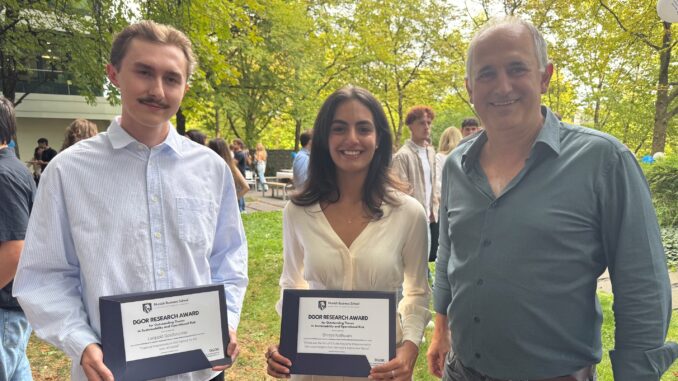
Following the award’s successful launch in 2025, Munich Business School (MBS) is pleased to announce the recipients of the 2026 DGOR Research Award, presented in collaboration with the German Society for Operational Risk Management (DGOR). The annual award recognizes outstanding final theses addressing sustainability and operational risk.
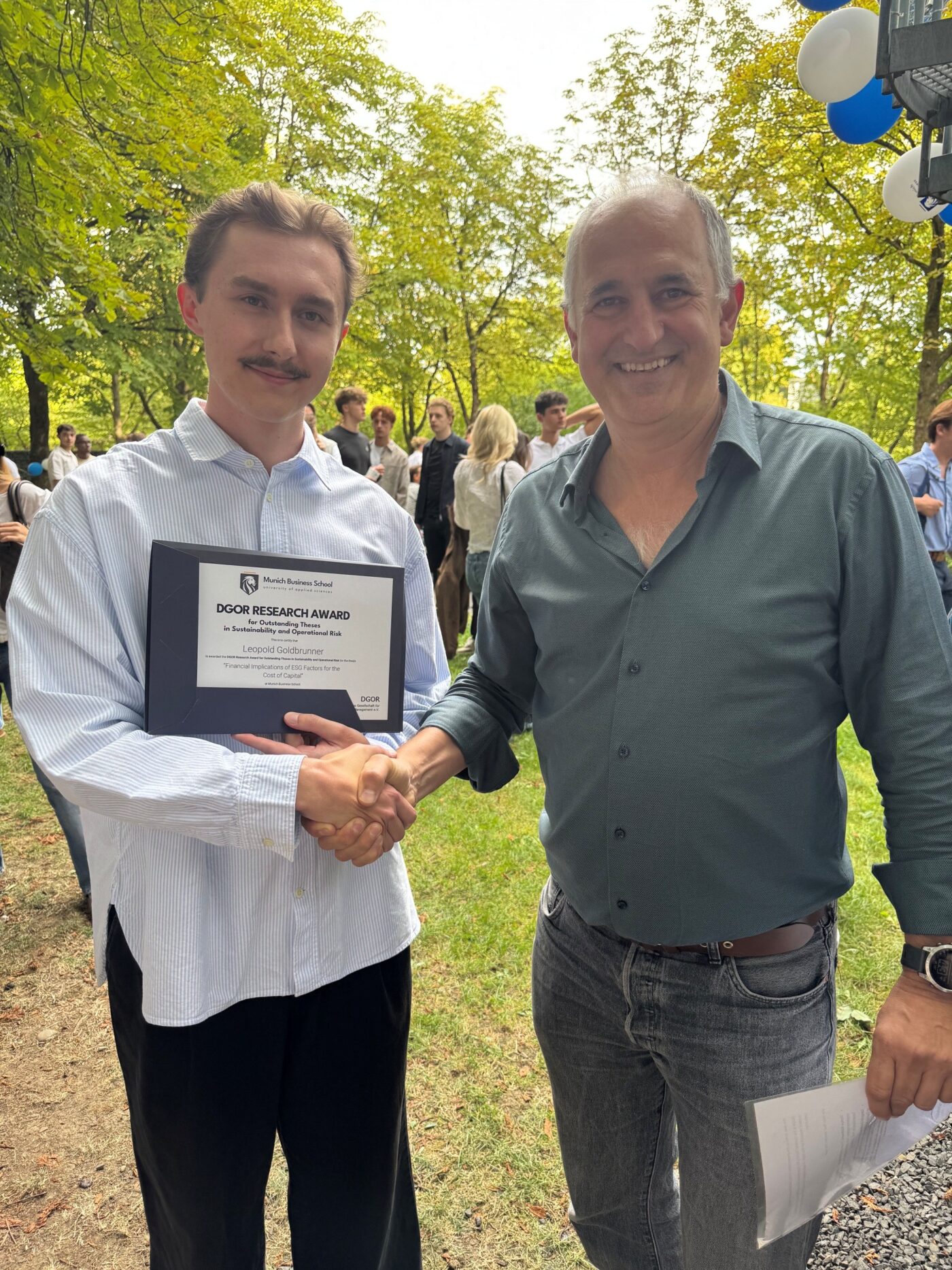
The MBS jury selected four graduates from a longlist of nine nominees, recognizing the quality, originality, and practical relevance of their research:
- Leopold Goldbrunner, for his systematic literature review Financial Implications of ESG Factors for the Cost of Capital. Supervisor: Prof. Dr. Eva Stumpfegger.
- Viola Antoniazzi, for her qualitative study Beyond Compliance: Turning Sustainability Reporting into Financial and Strategic Value. Supervisor: Prof. Dr. Johannes Hofinger.
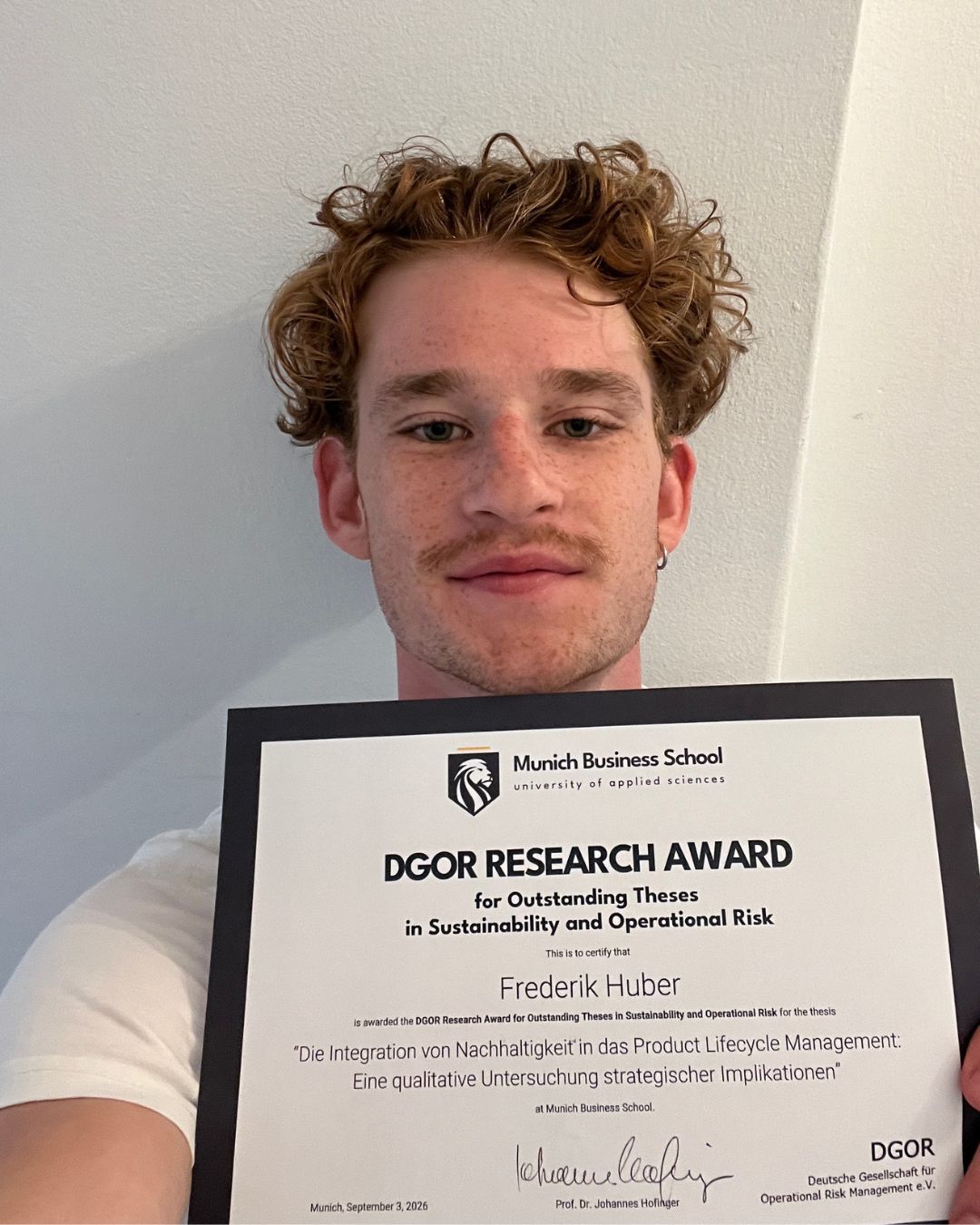
- Frederik Huber, for his thesis Die Integration von Nachhaltigkeit in das Product Lifecycle Management: Eine qualitative Untersuchung strategischer Implikationen (Integrating Sustainability into Product Lifecycle Management: A Qualitative Study of Strategic Implications). Supervisor: Prof. Dr. Nadine Chochoiek.
- Shreya Nathwani, for her study Drivers and Barriers of Circular Economy Implementation: Firm-Level Insights from Germany’s Automotive Sector. Supervisor: Prof. Dr. Nancy Landrum.
Congratulations to all recipients on this remarkable achievement. Munich Business School is honored to recognize the academic excellence of the students and proud to count them among our alumni.
Understanding the Financial Effects of ESG

Leopold Goldbrunner’s systematic review of 42 studies finds that stronger environmental, social, and governance profiles are generally associated with a lower cost of capital, although the relationship is not consistent under all conditions. The connection is clearest for the cost of equity, more varied for the cost of debt, and most dispersed for the weighted average cost of capital. His findings show that ESG should not be treated as a universal financial factor: its effects depend on the ESG dimension examined, the institutional context, the measurement approach, and the period under consideration.
From Reporting Requirements to Strategic Value
Viola Antoniazzi examines how organizations can move beyond regulatory compliance and turn sustainability reporting into financial and strategic value. Viola finds that sustainability reporting has become increasingly critical for businesses operating in ecologically sensitive fields. However, society still does not know enough about how it affects decision-making in small and medium-sized enterprises (SMEs). Her thesis analyzes the interpretation and utilization of sustainability indicators alongside financial ratios to aid sustainability-related investment decisions, prioritizing practicality and convenience over normative or ethical evaluation.
Integrating Sustainability into Product Lifecycle Management
Frederik Huber explores how environmental sustainability can be integrated into Product Lifecycle Management (PLM). Drawing on six expert interviews conducted across different industrial sectors, his research identifies important levers for reducing environmental impact as well as the challenges organizations face in implementing them. The findings provide practical insights into what companies need to make sustainable PLM successful.
Advancing Circularity in the Automotive Industry
Shreya Nathwani MBA examines recycling within a German automotive company as part of the broader transition from a linear to a circular economy. Based on expert interviews, she identifies regulation, technology, and organizational silos as closely interconnected factors affecting implementation. Her study also highlights the limitations of recycling as a circular strategy and points to the need for targeted organizational change.

Research with Practical Relevance
The second DGOR Research Award at MBS highlights the contribution that rigorous and applied academic research can make to more sustainable and responsible business practice.
As Prof. Dr. Johannes Hofinger, Professor of Finance and Accounting at Munich Business School, explains: “These theses reflect the analytical rigor, creativity, and real-world relevance that define the MBS spirit.”
Munich Business School congratulates all recipients on their achievements again. Their research offers valuable perspectives on some of the complex sustainability and risk-related questions facing organizations today.
For more information about the German Society for Operational Risk Management, visit www.dgor.org or connect with DGOR on LinkedIn.