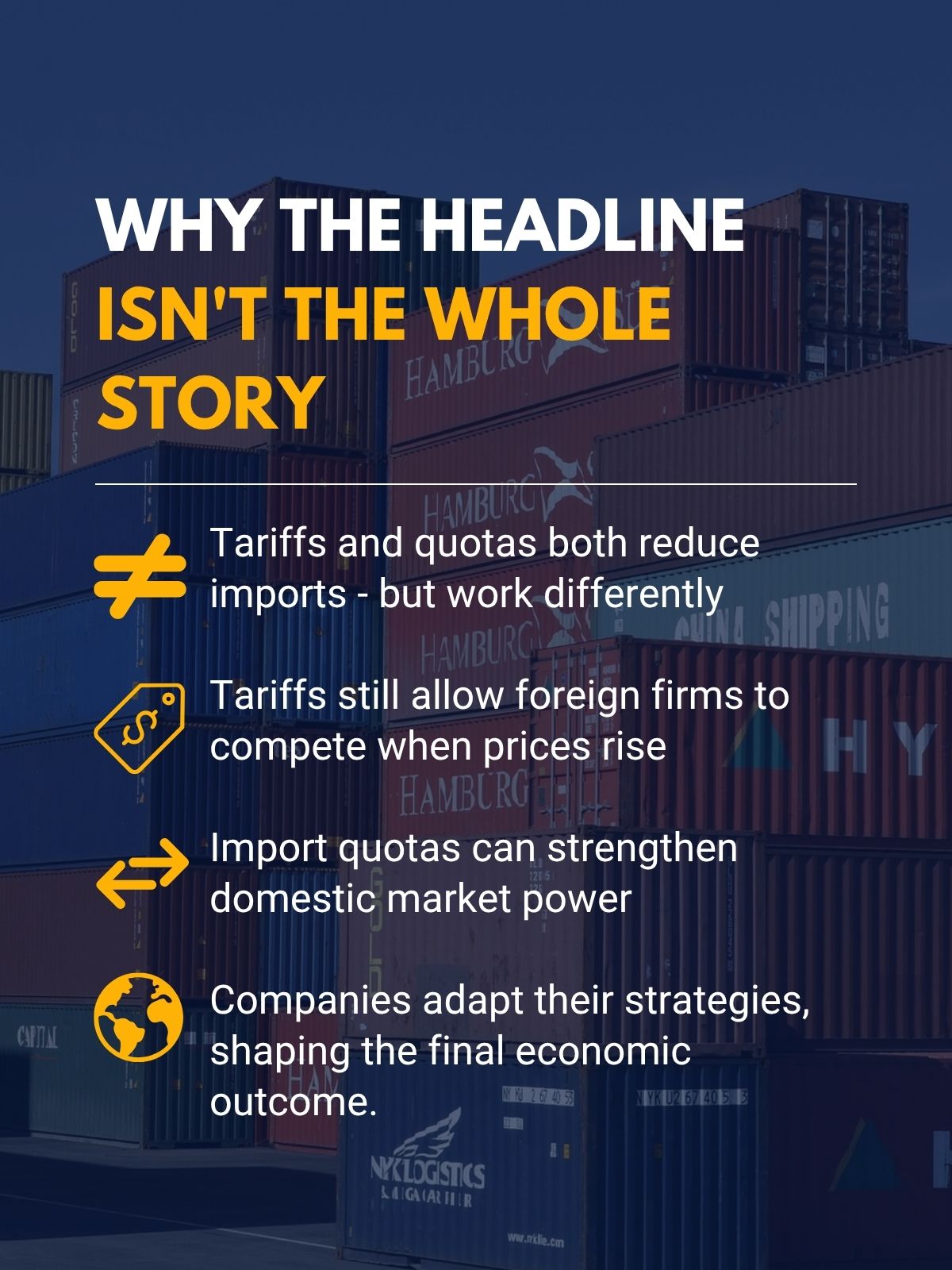

Trump put tariffs back on the agenda. Economics shows why the real story is more complicated.
Donald Trump’s tariff policy has brought international trade back into the political spotlight. The basic message often sounds straightforward: make imports more expensive, protect domestic producers, and bring production back home. But trade policy does not operate in such a simple way.
In their article in WISU, MBS Professor Florian Bartholomae together with Karl Morasch from the Bundeswehr University examine the different instruments governments use to influence trade, from tariffs and import quotas to subsidies, local-content requirements and public procurement rules.
One central lesson is that the choice of instrument matters.
A tariff and an import quota may initially appear to achieve the same objective: fewer imports and higher domestic prices. Yet their broader effects can differ substantially. A tariff still allows foreign suppliers to respond when domestic prices rise. A fixed quota can shield domestic companies much more strongly from foreign competition and may therefore reinforce market power.
Trade restrictions can also change corporate behavior in unexpected ways. When Japanese automobile exports to the United States were limited in the 1980s, manufacturers responded by exporting more expensive and higher-quality vehicles. If the number of cars was restricted, it made sense to increase the profit earned on each car.
Companies may also avoid trade barriers by relocating parts of their production. A policy designed to reduce foreign competition can therefore encourage foreign direct investment and reshape international supply chains.
This is why trade policy cannot be assessed by asking only whether it “protects domestic industry.”
We also need to ask:
- Who pays the higher price?
- Who receives the resulting income?
- How will companies adapt?
- And what happens to competition, product quality and production locations?
The current tariff debate is important. But the economic consequences depend not only on how much protection governments introduce, but also on how they design it.
Curious? Trade Policy is covered in the bachelor’s elective “Globalization and International Trade” as well as in the IB master’s elective “International Economic Relations.” Congratulations to Prof. Dr. Karl Morasch and Prof. Dr. Florian Bartholomae on this publication!