
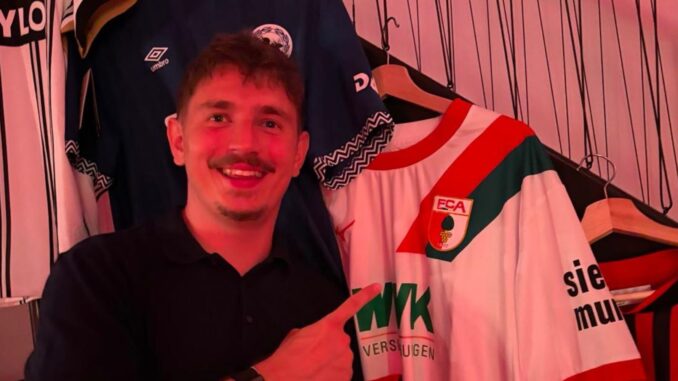
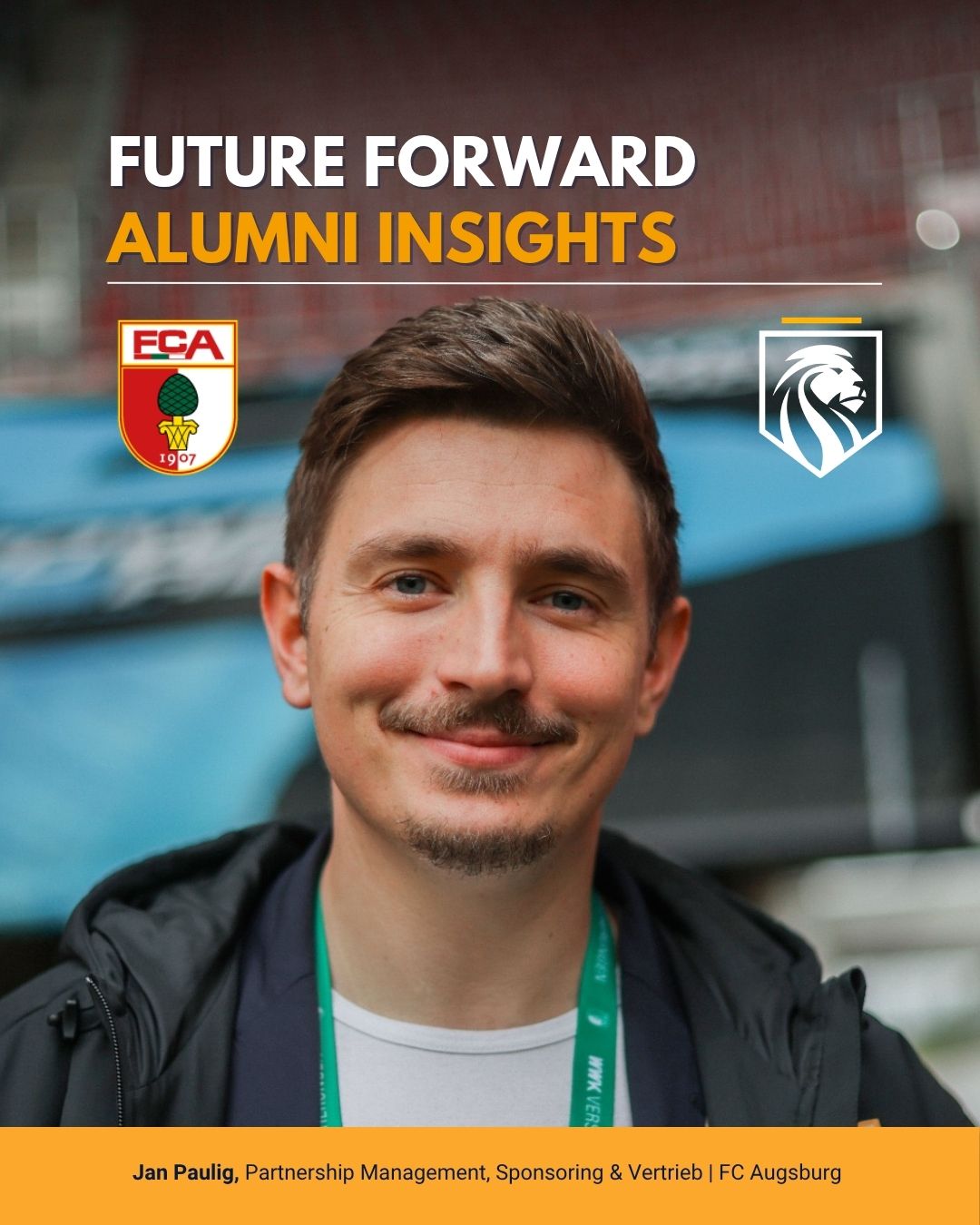
What happens when your favorite soccer club is also your employer? For Jan Paulig, this means experiencing soccer not only as a fan but also from an entirely new professional perspective. As an alumnus of the Master’s program in Sports Business & Communication (2020), he has been working in partner management at Bundesliga club FC Augsburg for three and a half years and experiences professional soccer up close.
Sports results take on a whole new meaning in this context: They’re not only experienced emotionally on the field and in the stands, but can also influence the work and atmosphere behind the scenes. In this interview, Jan discusses whether it’s even possible for an employee to still be a “normal” fan, how working for a club changes one’s perspective on soccer, and what makes everyday life in professional sports so special. He also shares insights into the future of sponsorship, his own path into the sports business, and his experiences as an MBS mentor.
Name: Jan Paulig
Study program and graduation year at MBS: Master in Sports Business & Communication, Graduation 2020
Current position: Partnership Management at FC Augsburg
Working at FC Augsburg
Could you briefly describe your current position at FC Augsburg?
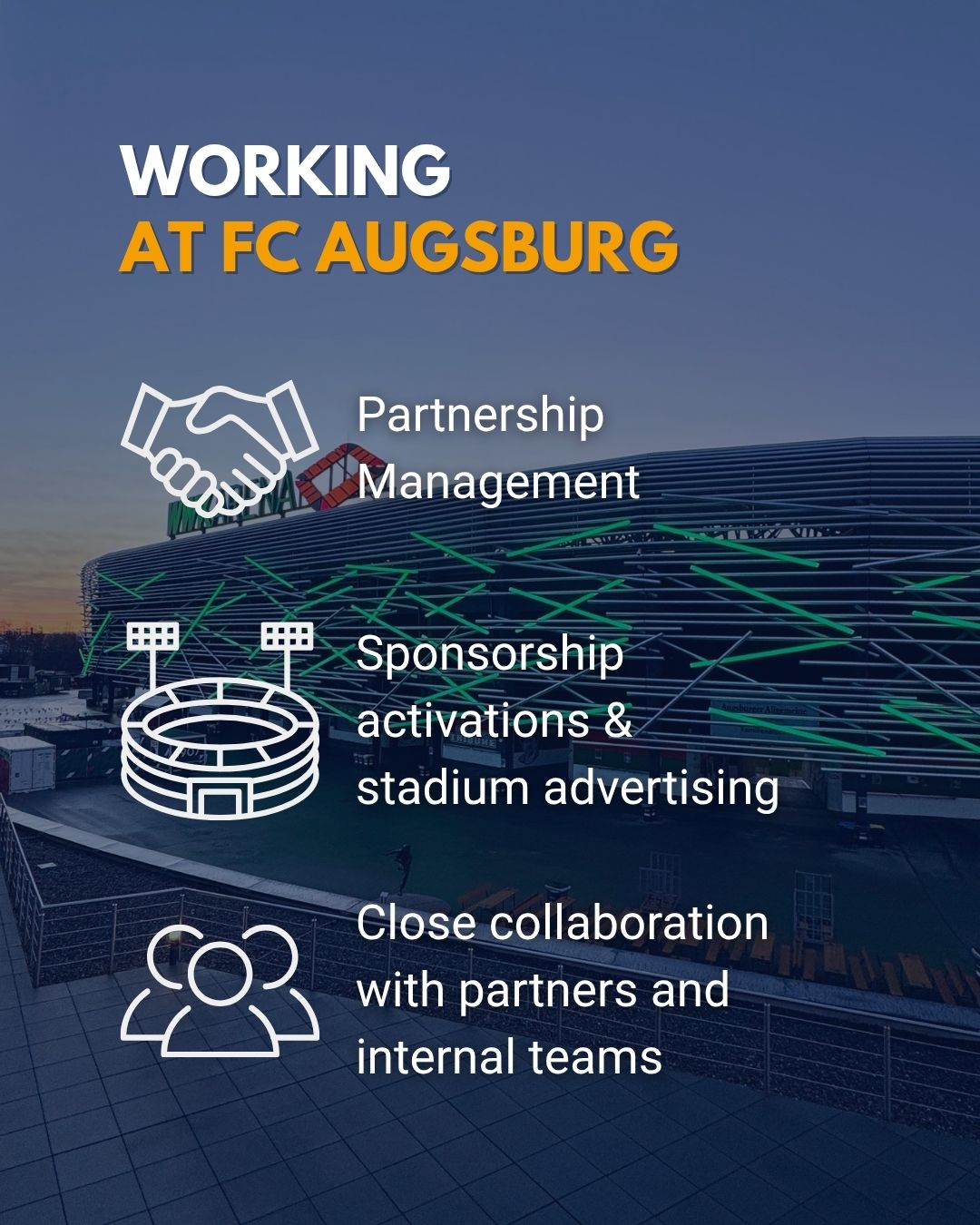
I’ve been working in partnership management at FC Augsburg for three and a half years. Our sponsorship division is divided into sales and partner management. Sales is handled by Sportfive, and we work closely with them.
Partner management is all about actively shaping partnerships and providing the best possible support to sponsors—from promotional materials in the stadium to social media campaigns, all the way to coordinating with internal departments such as graphic design, marketing, and stadium operations. This gives you a wealth of insight into the entire club.
Are you active every game day?
Yes, home game days are some of our most important workdays. Everyone has their own areas of responsibility. For example, I’m in charge of the advertising materials in the stadium—LED video boards, partner visibility, and similar matters. At the same time, it’s naturally a very special emotional experience to enjoy the games together with our partners.
Is it even possible to still be a fan if you work there?
I’ve always been a supporter of FC Augsburg, but when you work for a club like this, you automatically become an even bigger fan. You want the club to succeed, you get caught up in the excitement, and you want to do your part to help make that happen.
Of course, your perspective on soccer changes a bit, too, because so much of it suddenly becomes part of your daily work routine. At the same time, though, that emotional connection remains—perhaps even stronger than before, because you experience the club firsthand every day and work toward the same goals together with everyone involved.
Does this behind-the-scenes look take some of the magic out of the Bundesliga?
It changes your perspective, but I wouldn’t say it takes the magic away. You still feel the pain of defeat and celebrate victories just as much as the fans do. At the same time, of course, you also realize that your own professional life—and, to some extent, your personal success—is tied to the club’s performance on the field.
Off the field, we try to do everything as well as possible—from partnerships to the matchday experience. Of course, we have no direct influence on the actual gameplay; that’s up to the team. But it’s precisely this interplay that makes professional sports special: everyone does their part to ensure the club’s success.
Occupational Disease Sponsorship
When you watch soccer, do you find yourself looking at the advertising boards first these days?
Absolutely. Whether I’m at the stadium or watching on TV—my first glance always goes to the promotional materials, the LED billboards, and the sponsor activations. It’s become second nature to me by now.
What Makes a Job in the Sports Business Special
What sets your daily routine apart from a traditional corporate job?
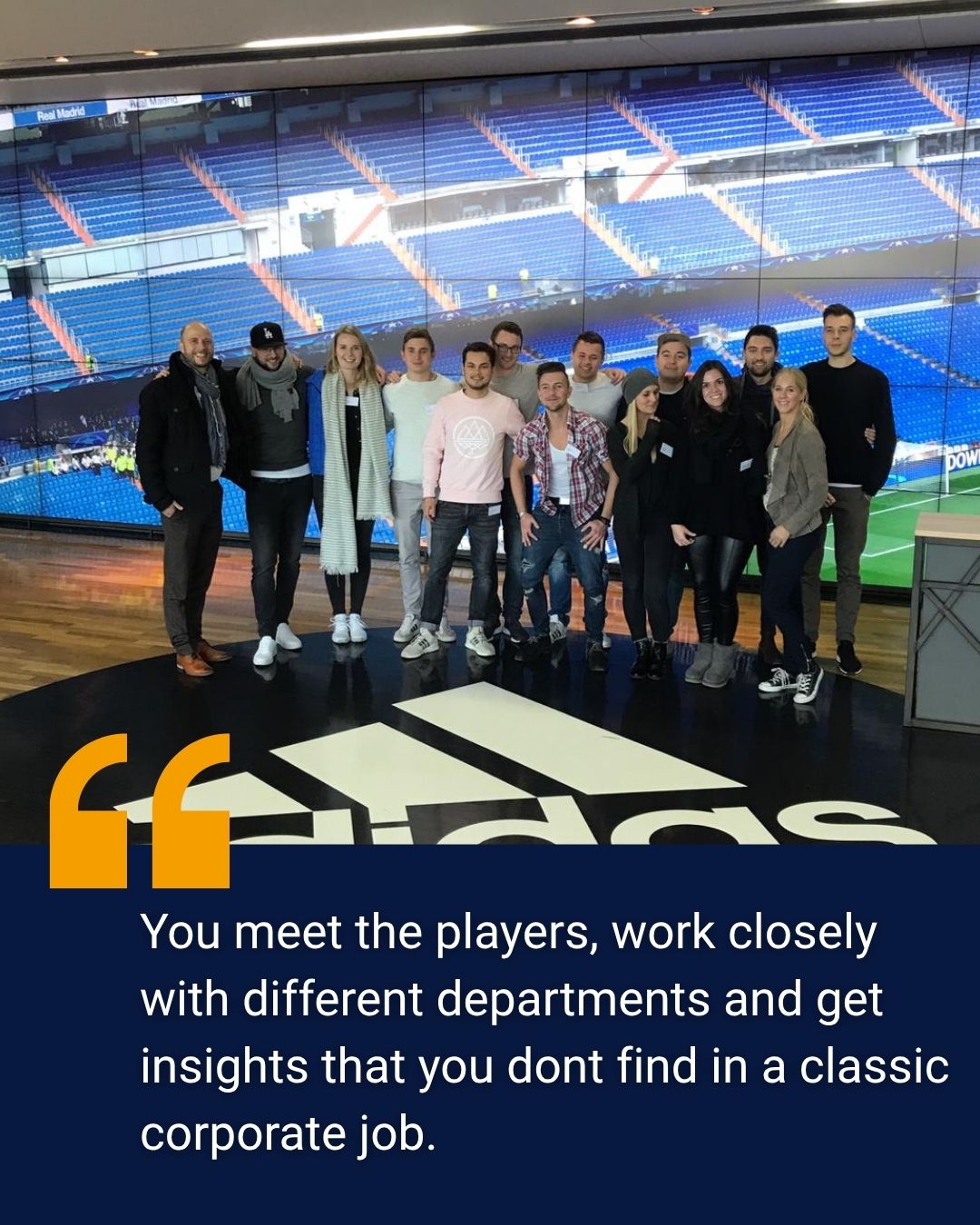
Definitely the close proximity to the stadium and the team. We work right at the arena, run into the players every day, and sometimes even have lunch with them. That gives you a very direct insight into professional sports.
At the same time, though, you quickly realize: At the end of the day, they’re just regular people. To outsiders, of course, this seems special, but for us, this contact eventually becomes part of our everyday routine. It’s exactly this mix of a special atmosphere and a normal workday that makes the job exciting.
Plus, there’s no such thing as a typical workday. There are home game weeks with a lot of operational work and away game weeks focused on strategic issues or coordinating with partners. It’s precisely this mix that keeps the work interesting.
How did you get into professional soccer?
My bachelor’s degree was in traditional business administration with a focus on marketing. Afterward, I realized I wanted to do something more closely related to my passion for sports. Sports have always been a big part of my life.
Through the Munich Business School, I discovered the master’s program in Sports Business & Communication and enrolled in it. During my studies, I realized that sponsorship is exactly the mix of communication, creativity, and interpersonal interaction that appeals to me.
After graduation—right in the middle of the COVID-19 pandemic—I first gained experience through various roles in the sports business, including accreditation management for UEFA and the DFB, and later at an agency specializing in telecom sports sponsorship. After that, an opportunity arose at FC Augsburg.
What Sticks With You From your Studies
What aspects of your college studies are helpful to you today?
The following were particularly helpful:
- insights into sports management and sponsorship,
- presentations and oral exams,
- as well as business projects with real companies.
And, of course, the network. Many former classmates now hold exciting positions in the sports industry.
What role does networking play in the sports business?
The network is a huge help—for sharing ideas, finding inspiration, and discovering opportunities to get started. But in the end, what really counts is your own work, your motivation, and how you interact with people.
What advice would you give to students who want to go into the sports business?
Internships are extremely important. You should figure out as early as possible which fields are truly a good fit for you. You should also be open to connecting with people, take advantage of your networks, and gain practical experience.
The Future of Sponsorship
What developments do you find exciting right now?
Sponsorship is changing dramatically. In the past, it often revolved around traditional advertising banners or the fact that a decision-maker was simply a fan of a club and therefore entered into a sponsorship agreement. Today, sponsorship is evaluated much more on the basis of data and KPIs.
Companies look very closely at:
- Which target audiences are reached?
- What is the reach?
- What advertising value and effects can be measured?
- How can sponsorship be integrated into the overall marketing strategy?
At the same time, the focus is shifting more and more toward digital activations and social media. It’s no longer enough to simply place a logo—content must be authentic and offer real added value or entertainment.
It’s also interesting to note that sponsorship now often extends far beyond traditional marketing goals. In some cases, clubs today no longer engage solely with marketing departments but also with HR departments when it comes to issues such as employer branding or employee retention.
What skills are particularly important in your industry right now?
Commitment, openness, and motivation play a major role. At the same time, traditional qualities such as diligence, reliability, and good interpersonal skills remain extremely important. Especially in the sports business, you work very closely with a wide variety of people.
And there’s actually a lot you can learn. If you’re truly interested in a field and willing to invest time and energy, you can learn an incredible amount. Above all, it’s important to stick with it and gain practical experience.
Mentoring: Sharing Experiences
You’re now also active as a mentor at MBS. What motivated you to do that?
I find mentoring extremely valuable because both sides can learn from each other. Especially at the start of one’s career, it helps immensely to have someone with whom you can have an open dialogue and who may already have some experience.
That’s why I was immediately intrigued by the Munich Business School’s mentoring program. There, I can share insights from my own career, answer questions, and support students as they find their own path in the sports business.
Do you stay in regular contact with your mentee?
Yes, we check in with each other regularly—sometimes briefly via WhatsApp, other times in more detail in person or over the phone. It’s important to me that there’s always someone available to turn to with questions or concerns. In my view, that’s exactly what mentoring is for.
A Piece of Advice for My Younger Self
What advice would you give your younger self as a student?
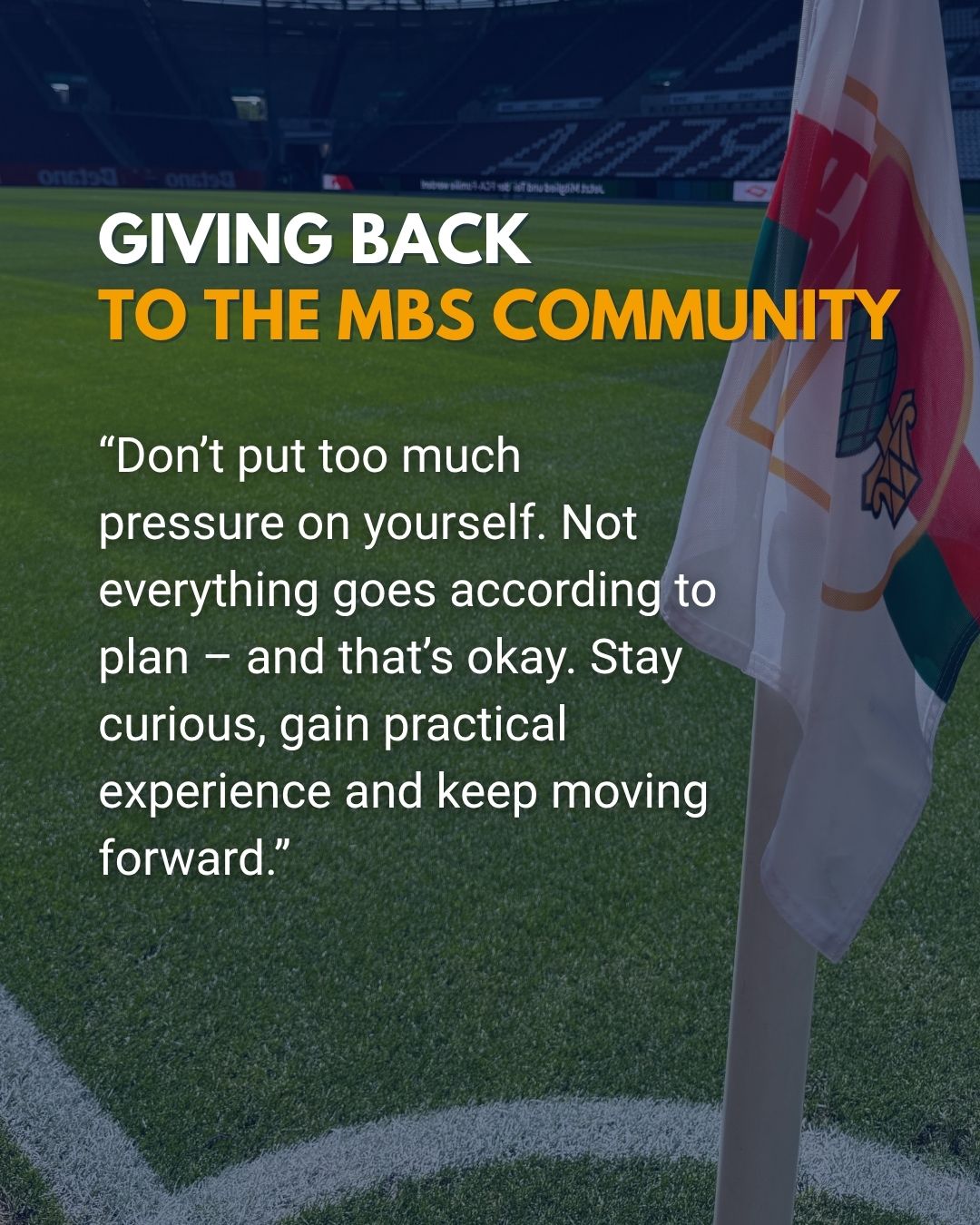
Don’t put so much pressure on yourself. Things don’t always go according to plan—and that’s totally okay. Mistakes are part of the process. The important thing is to keep at it and not get discouraged when things don’t work out right away.
The interview was conducted by Dr. Lea Krähahn, Head of Alumni Relations at the Munich Business School.