Last chance: €4,000 Early Bird discount  on all MBA applications with deadline April 30, 2026
MBS Logo

CapEx

CapEx refers to investments that a company makes in order to acquire long-term corporate assets. In our business dictionary, we take a detailed look at the term CapEx and explain it using concrete examples. Here you will learn everything you need to know!

What is CapEx?

CapEx stands for "Capital Expenditures" and refers to the investments a company makes to acquire, improve or maintain long-term assets such as buildings, land, machinery or equipment. CapEx includes expenditures on physical assets that are necessary for the company's operations and are expected to provide benefits over an extended period of time. Asset investments are usually significant and can affect the financial position, future growth, and profitability of the business. Therefore, they are often carefully planned and evaluated before decisions are made. [1]

Interested in Studying Business Administration?

Capex Definition

A CapEx investment is a financial investment in tangible assets that are necessary for a company's operations or production. CapEx stands for capital expenditure and refers to investment spending on long-term assets. It is important to understand that CapEx is not a form of financing, but rather describes the actual spending on tangible assets. These investments can be financed from various sources, such as equity or loans. However, this does not change the fact that CapEx represents the actual investment in long-term goods. For example, a company can pay for a new machine (CapEx) either with a bank loan or from its own cash flow. The CapEx remains the expenditure for the machine, while the loan is only one of the possible financing types. [2]

Capex Meaning

CapEx is short for capital expenditures and refers to investment spending in long-term assets (fixed assets). These expenditures include new buildings, machinery, and other equipment needed for an organization's day-to-day operations. Most companies use capex financing to fund their long-term investments. Capex must be financed, either through equity (reinvested profits) or debt (e.g., bank loan, leasing). If a company uses equity, there is no interest and no fixed repayment schedule as with a loan. However, this is an advantage of the equity financing method or internal financing, not an inherent advantage of CapEx itself. CapEx refers to the investment expenditure – how it is financed depends on the company's financial strategy. [3]


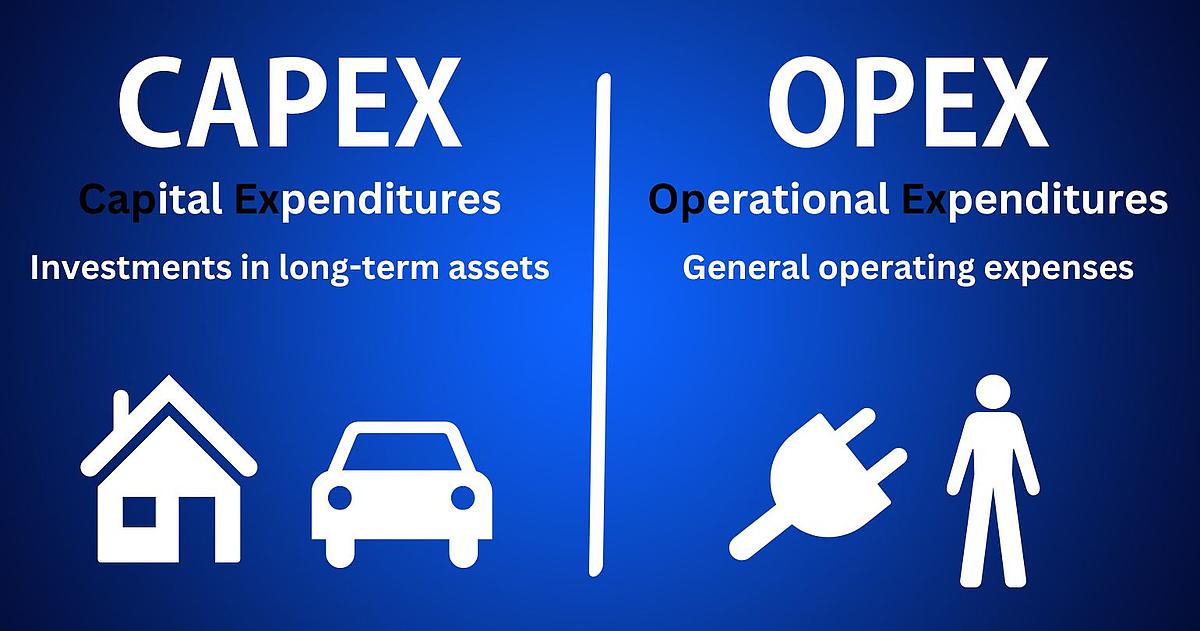
Comparison of Capex Opex: House and car represent investments, electricity and personnel represent running costs.

CapEx vs. OpEx: What is the difference between CapEx and OpEx?

CapEx (Capital Expenditures) and OpEx (Operating Expenses) are two different types of business expenses:

  • CapEx refers to investments in long-term assets such as buildings, land, machinery or equipment. These expenditures are typically large and are used to build, improve or expand the company's infrastructure. CapEx expenditures are typically recorded as assets on the company's balance sheet and depreciated over several years because they are expected to provide benefits over a longer period of time.
  • OpEx, on the other hand, refers to the general operating expenses associated with the day-to-day operations of the business. These include expenses such as rent, salaries, utilities, marketing and sales, office supplies, and other similar costs. These expenses are usually recorded in the company's income statement and have a direct impact on the company's profit in a given fiscal year.

In a nutshell, CapEx differs from OpEx in that CapEx is spending on the long-term investment in assets of the business, while OpEx is spending on the day-to-day operations of the business.

Interested in Studying Business Administration?

Examples CAPEX vs. OPEX

This table provides a quick overview of the different types of colloquia, their respective objectives, the typical audience, and the level of interaction and discussion expected.
CAPEX OPEX
Building Raw materials for production
Machines Rent
Land Personnel expenses
Spare parts Leasing fees
Computer systems License fees
Office equipment Interest expense
Vehicles Depreciation

How is CapEx calculated?

The calculation of CapEx (capital expenditures) depends on the type of investment the company is making. In general, however, CapEx includes all expenses for the purchase, improvement or maintenance of long-lived assets such as buildings, machinery or equipment. There are various methods for calculating CapEx, but here are two common approaches:

  1. Direct Method: The direct method of calculating CapEx is to determine the total expenditure on assets in the fiscal year and then deduct the amounts for the disposal or sale of assets in the same fiscal year. The formula is:
    CapEx = Total expenditure on assets - Proceeds from the sale of assets
  2. Indirect Method: The indirect method of calculating CapEx is through depreciation of long-lived assets. The formula is:
    CapEx = Depreciation and amortization + Change in carrying amount of assets (end – beginning)

    The change in the carrying amount of assets is calculated by deducting the carrying amount of the asset at the end of the year from the carrying amount of the asset at the beginning of the year.

It is important to note that the calculation of CapEx may vary by company and industry, and that the choice of calculation method may vary by company. [5]

Interested in Studying Business Administration?

What is CapEx planning?

CapEx planning is an important part of a company's financial planning, planning for long-term investments in assets such as buildings, machinery or equipment. It refers to the processes and procedures companies use to plan and manage their capital expenditures for the coming years.

CapEx planning can help ensure the company's financial stability and growth potential by ensuring that the company has sufficient resources to meet its future plant and equipment needs. Planning can also help improve the company's efficiency and profitability by ensuring that investments are targeted to those assets that will contribute most to increasing the company's value.

It typically involves a careful analysis of the estimated costs of acquiring and maintaining assets, identifying major capital projects, and determining the time frame for their implementation. CapEx Planning may also include an evaluation of financing options for capital expenditures, including internal financing and external financing through debt or equity offerings. [6]

FAQ

Is rent CapEx?

+

Are repairs CapEx?

+
Are you interested in studying at MBS?

Our university. Awarded and accredited.

Did you find this article helpful? Do you have any suggestions or questions about this article? Have you noticed something or is there a topic you would like to know more about? Your feedback is important to us! It enables us to constantly improve our offer and provide you with exactly the content you are interested in.
Contact editorial office

Note on readability and salary information: The salary ranges given refer to Germany.
 

Our Sources

Transparency is important to us

[1] CAPEX (Kapitalausgaben) – Bedeutung, Definition & Beispiele – Symestic GmbH (BWL-Guide), 2023: symestic.com/de-de/was-ist/capex

[2] CAPEX • Definition | Gabler Wirtschaftslexikon: wirtschaftslexikon.gabler.de/definition/capex-52700

[3] Capital Expenditures (CapEx) – Investopedia, J. Fernando, 2023: investopedia.com/terms/c/capitalexpenditure.asp

[4] Operating Expense (OpEx) Definition and Examples: investopedia.com/terms/o/operating_expense.asp

[5] Capital Expenditures (CapEx) – Investopedia, J. Fernando, 2023: investopedia.com/terms/c/capitalexpenditure.asp

[6] Principles of Corporate Finance – Brealey, Myers & Allen, 2020 (Lehrbuch)

[7] IFRS 16 Leases – IASB Standard – IFRS-Stiftung, 2016: accaglobal.com/us/en/student/exam-support-resources/fundamentals-exams-study-resources/f7/technical-articles/ifrs16.html

[8] Governance & Assurance of Capex Spending – CFBL Consulting, 2022: cfbusinesslinks.com/governance-assurance-of-capex-spending