Last chance: €4,000 Early Bird discount  on all MBA applications with deadline April 30, 2026
MBS Logo

Progress Payment

The financial management of projects or deliveries often presents challenges, especially when it comes to ensuring a continuous cash flow. In many industries and business relationships, a method called Progress Payment has become established, providing both contractors and clients with a degree of certainty and ensuring the smooth continuation of projects. This article looks at the mechanics and benefits of this practice, highlights typical areas of application and addresses potential risks.

What is a Progress Payment?

A Progress Payment is a partial payment that is made before a service or delivery is provided in full. This payment is usually made in several installments and serves to provide the contractor with funds to cover ongoing costs and to advance the project. This practice is common in many industries, particularly in construction and long-term service contracts.

Where are Progress Payments used?

Progress Payments are used in a variety of situations and industries to ensure the financial stability and progress of projects. Here are some typical areas of application:

Construction industry

  • Large projects: Progress Payments are common for construction projects that extend over a long period of time. They allow construction companies to cover material costs and labor wages on an ongoing basis.
  • Milestones: Progress Payments are often agreed upon after certain project milestones are reached to ensure that construction progress meets expectations.

Service contracts

Long-term services: Progress Payments are often agreed for long-term service contracts, such as consulting or IT services, to ensure that the service provider is paid regularly for their work.

Manufacturing processes

Production orders: Progress Payments are common in the manufacturing industry, especially for the production of custom-made products or large machines, to cover production costs.

Energy industry

Utility companies: Customers of energy supply companies often make Progress Payments to cover their monthly or quarterly electricity or gas consumption.

Contract work

Creative projects: Progress Payments can be used for contract work such as design, architecture or software development to fund the stages of the work.

Public contracts

Government projects: Progress Payments are a common practice in public contracts and government-funded projects to ensure that funds are used efficiently and the project progresses on schedule.

Progress Payments provide security and financial predictability to both contractors and clients. They help to avoid liquidity bottlenecks and minimize risk for both parties.

Interested in Studying Business Administration?

Progress Payment Disadvantages & Advantages

This table provides an overview of the main advantages and disadvantages of Progress Payments and can serve as a basis for deciding whether and how Progress Payments should be implemented in a company.

Advantages Disadvantages
Financial security: Contractors and employees receive funds at an early stage to cover running costs and avoid financial bottlenecks. Administrative effort: Increased administrative effort for processing and approving Progress Payments.
Liquidity: Constant availability of funds to continue projects or cover personal expenses. Risk of abuse: Risk of repeated requests for Progress Payments, which can lead to financial difficulties in the long term.
Planning security: Clients and contractors can plan better and complete projects on time. Lack of reserves: Employees may build up fewer reserves if they regularly use Progress Payments.
Motivation and satisfaction: Can increase the satisfaction and motivation of employees and contractors as they feel financially supported. Financial burden on the company: Can affect the company's liquidity if many Progress Payments are granted at the same time.
Risk minimization: Clients can ensure that projects progress according to plan and that the quality of the work is guaranteed. Unclear regulations: Without clear guidelines, misunderstandings and dissatisfaction can arise.
Flexibility: Provides a flexible salary structure and financial support in emergencies. Interest-free credit: For the employer or client, it can act as an interest-free loan that ties up financial resources.
Attractive employer: Can increase the attractiveness of the company as an employer and contribute to employee retention. Possible dependency: Employees could become accustomed to regular Progress Payments and lose financial discipline as a result.

Rules and Requirements for Progress Payment

Progress Payment rules and requirements can vary by company and industry, but there are some general principles that should be followed. Here are the most important rules and requirements:

General Rules for Progress Payments

  1. Contractual agreement: Progress Payments should be regulated in the employment contract or by a company agreement. This ensures that both parties are aware of the conditions.
  2. Application: The employee must make a formal request for a Progress Payment. This can be done in writing or electronically, depending on the company's internal guidelines.
  3. Approval process: The Progress Payment request must be reviewed and approved by Human Resources or a supervisor. This ensures that the request is justified and that the company's financial situation is taken into account.
  4. Amount of Progress Payment: The amount of the Progress Payment should not exceed a certain percentage of the net salary to ensure that the employee has sufficient funds available after the Progress Payment.
  5. Repayment modalities: Progress Payments are usually deducted from the next regular salary payment. It should be clearly regulated how and when repayment is made.

Requirements for Progress Payments

  1. Duration of employment: In some companies, the employee must be employed for a certain period of time (e.g. six months) before they can apply for a Progress Payment.
  2. Regularity: It should be specified how often Progress Payments can be requested (e.g. once per quarter) to avoid abuse.
  3. Justification: The employee must provide a plausible justification for the Progress Payment, e.g. unexpected expenses, medical emergencies or urgent financial obligations.
  4. Financial situation of the company: The financial situation of the company must allow Progress Payments to be granted without jeopardizing liquidity.

Practical Implementation for Progress Payments

  1. Clear communication: The rules and requirements for Progress Payments should be communicated clearly and transparently. This can be done through training, internal guidelines or employee handbooks.
  2. Documentation: All applications and approvals should be carefully documented to ensure transparency and traceability.
  3. Monitoring and control: There should be a system for monitoring and controlling Progress Payments to ensure that the rules are followed and that there are no cases of abuse.

By setting clear rules and requirements for Progress Payments and communicating these transparently, companies can both meet the needs of their employees and ensure the financial stability of the company.

What role does Financial Planning play in this?

Terms for Progress Payment

This table provides an overview of the most important terms that are relevant in connection with Progress Payments and explains their meaning and application.
Term Description
Progress Payment A partial payment that is made before a service or delivery is provided in full. It is used to cover ongoing costs and to ensure the progress of the project.
Final invoice The final invoice issued after the contractually agreed services or deliveries have been provided in full. It summarizes all services rendered and represents the final invoice.
Advance payment An advance payment made before the start of or during a project to secure future services or deliveries. Often intended as security for the contractor.
Partial invoice An invoice issued for a self-contained partial service or delivery within an overall project. It is based on the contractually defined milestones or partial phases.
Income taxation The tax recognition and taxation of income generated by Progress Payments. They must be taxed in the period in which they are received.
Value added tax (VAT) The tax levied on the net amount of the Progress Payment. VAT must be reported and paid in the pre-notification period in which the payment was received.
Input tax deduction The deduction by the client of the VAT included in the Progress Payment, provided that the invoice is correct and the service was purchased for the company.
Security retention A contractually agreed amount withheld by the client to ensure that the contractor completes the work properly.
Accrual accounting The accounting recognition of income and expenses in the year in which the related service was performed. Progress Payments must be recorded correctly on an accrual basis.
Milestones Contractually defined interim targets in a project, which often serve as the basis for the calculation and due date of Progress Payments.
Invoicing The process of creating and sending an invoice detailing the partial services rendered and the VAT due on them.
Liquidity The availability of financial resources, which is improved by Progress Payments, to finance ongoing costs and project progress.
Breaches of Contract Breaches of contractual terms and conditions that can lead to the refusal of a Progress Payment.
Documentation The detailed recording and verification of services rendered and Progress Payments made to ensure transparency and traceability.

Progress Payments Salary

Progress Payments in the context of salary are partial payments made to an employee before the regular salary payment date. This practice can be used in various situations:

  1. Financial hardship of the employee: Employees who have unexpected financial burdens can request a Progress Payment to cover urgent expenses.
  2. Irregular income: In industries or positions with irregular income or seasonal fluctuations, Progress Payments can help provide financial stability.
  3. Agreed advances: Some employment contracts specify advances on salary as part of the agreement. This may be the case for project work or fixed-term contracts, for example.
  4. Special events: Employees* can ask for an advance payment on the occasion of special events, such as weddings, relocations or medical emergencies.

Progress Payments offer a flexible way to bridge financial bottlenecks, but require clear rules and careful administration to avoid disadvantages.

Interested in Studying Business Administration?

Factors for the amount of the Progress Payment

The amount of the Progress Payment is determined based on various factors designed to ensure that the payment is both fair and reasonable.

Overview: Factors for the Amount of the Progress Payment

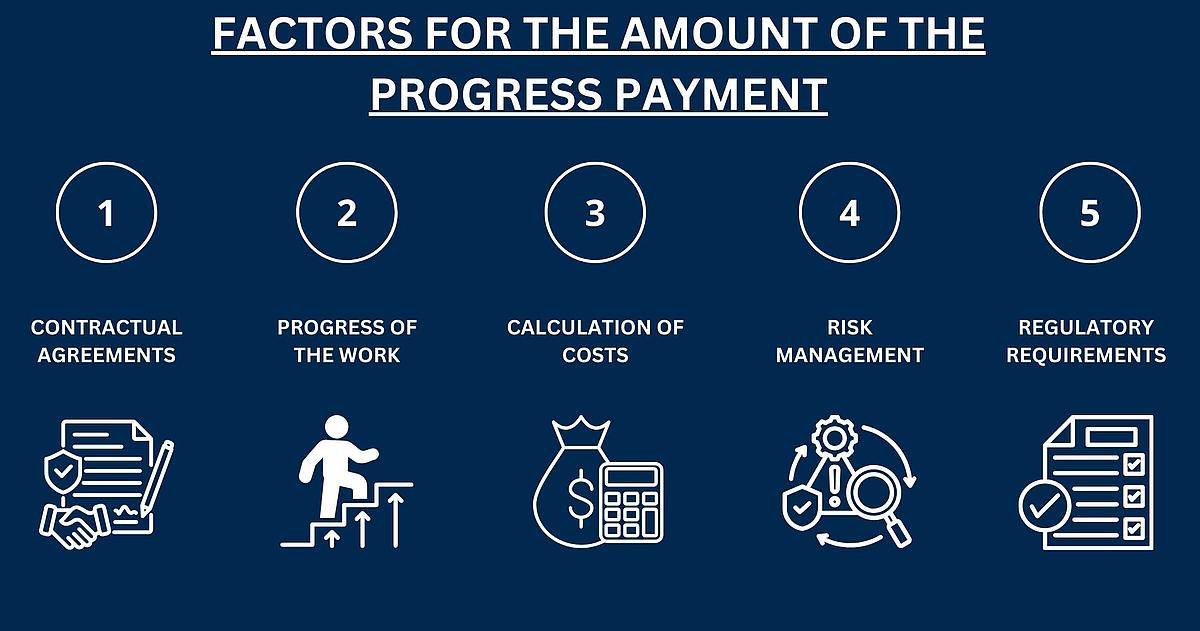
The following diagram shows an overview of the factors for the amount of the Progress Payment.

The chart shows five factors that influence the amount of the down payment, including costs, risk, and contract basis.

Explanation: Factors for the Amount of the Progress Payment

Here is a more detailed explanation of the main steps and considerations that go into determining the amount of a Progress Payment.

Contractual Agreements

  • Fixed percentages: In many contracts, a certain percentage of the total amount is agreed as a Progress Payment. For example, in a construction contract, 20% of the total costs could be due after certain milestones have been reached.
  • Milestones and project phases: Payment can be linked to the achievement of certain milestones or completed project phases.

Progress of the Work

  • Services rendered: Progress Payment amounts are often based on work already completed. The value of the work already carried out or materials already delivered is estimated and invoiced.
  • Project status reports: Regular reports on the progress of the project help to assess the actual status of the work and to invoice accordingly.

Calculation of Costs

  • Material and Labor Costs : Progress Payment should cover the material and labor costs incurred up to a certain point in time.
  • Additional expenses: In addition to direct costs, overhead, transportation and other project-related expenses may also be included.

Risk Management

  • Financial security: Progress Payments should be calculated in such a way that they provide the contractor with financial security without unnecessarily burdening the client.
  • Security retentions: Progress Payments are sometimes reduced by security retentions to ensure that the contractor completes the work properly.

Regulatory Requirements

  • Legal requirements: In some industries and countries, there are legal requirements that govern how Progress Payments are calculated and when they are due.

Example Calculation of a Progress Payment

Let's assume a construction project has a total volume of 500,000 euros. The contract stipulates that 20% of the total amount is due as a Progress Payment once the foundations have been laid.

  1. Total project sum: 500,000 euros
  2. Percentage of Progress Payment: 20%
  3. ProgressPayment amount: 500,000 euros x 20% = 100,000 euros

The amount of the Progress Payment is determined by contractual agreements, the progress of the work, the calculated costs, risk management and any applicable legal provisions. Through careful calculation and clear communication between the contracting parties, the Progress Payment can be determined fairly and appropriately.

Interested in Studying Business Administration?

When can Progress Payment be refused?

Progress Payment can be refused in certain cases if certain requirements or conditions are not met. Here are the most common reasons why a Progress Payment may be refused:

Reason Example Explanation
Non-fulfillment of contractual agreements Missing services If the contractor has not provided the agreed partial services or has provided them inadequately, the client can refuse Progress Payment.
Deviations from specification If the services provided do not meet the contractual specifications or quality standards, this may be a reason for refusal.
Insufficient documentation Lack of evidence If the contractor has not sufficiently documented or provided evidence of the services rendered, the client may withhold payment.
Incomplete invoices An incomplete or incorrect partial invoice can lead to refusal of payment.
Breaches of contract Failure to meet deadlines If contractually agreed deadlines have not been met, this may be a reason to refuse Progress Payment.
Breach of contract terms Any breaches of the contractual terms can lead to a refusal of Progress Payment.
Contractor's financial problems Risk of insolvency If the client has reasonable doubts about the contractor's solvency or financial stability, it may refuse Progress Payment to protect itself from losses.
Defects in performance Defects in work If defects are found in the work that have not been remedied, Progress Payment may be withheld.
Unresolved complaints Unresolved or unresolved complaints may be grounds for refusal of payment.
Missing or insufficient security retentions No security retentions If contractually agreed security retentions have not been provided, this may be a reason for refusing Progress Payment.
Legal provisions Compliance with legal requirements If the Progress Payment violates applicable legal provisions or regulations, it may be refused.

Progress Payment can be refused for various reasons, mostly related to non-fulfillment of contractual agreements, lack of documentation, performance issues or financial problems of the contractor. Both the client and the contractor should make clear contractual agreements and adhere to them in order to avoid misunderstandings and payment problems.

What role does Cash Flow play in this?

Progress Payment in Tax Law

The tax treatment of Progress Payments varies depending on the country and specific tax regulations. In general, however, there are some basic principles that apply in many jurisdictions. Here are the most important aspects of the tax treatment of Progress Payments:

Income Taxation

  1. Income tax (income from business operations):
    • Progress Payments represent income subject to income tax for the recipient (e.g. construction company). They must be taxed in the period in which they are received, i.e. when the contractor actually receives the payment.
  2. Determination of profit:
    • Progress Payments must be recognized as operating income when determining profits in accordance with Section 4 (1) EStG (business assets comparison) or Section 4 (3) EStG (revenue-surplus accounting).
    • In the balance sheet, they must be capitalized as part of the receivables if the associated service has already been rendered but not yet fully settled.


Value Added Tax (VAT)

  1. Time of performance:
    • The time of performance is decisive for VAT treatment. Progress Payments are subject to VAT as soon as the partial service has been provided.
    • VAT must be reported and paid in the pre-notification period in which the Progress Payment was received.
  2. Invoicing:
    • A proper invoice for the Progress Payment must show the VAT. The invoice should list in detail the partial services rendered and the VAT amount due on them.

Input Tax Deduction

  1. For the client:
    • The client can generally deduct the input tax contained in the Progress Payment immediately, provided the invoice contains all the required information in accordance with Section 14 UStG and the service was purchased for the company.
    • Input VAT is deducted in the pre-notification period in which the invoice is issued and the Progress Payment is paid.

Bookkeeping

  1. Recording the Progress Payment:
    • Progress Payments must be recorded as revenue in the accounting system as soon as they are received. At the same time, the associated VAT must be recorded.
    • The entry is usually made as follows:
      • Debit: Bank (for receipt of payment)
      • Credit: Sales (for the revenue)
      • Credit: Sales tax (for the sales tax owed)

Financial Statements

  1. Accruals and deferrals:
    • Progress Payments must be recorded correctly at the end of the year as part of accrual accounting. This means that income and expenses are recorded in the year in which the corresponding service was provided.
    • Any services not yet rendered that have already been financed by Progress Payments must be recognized as liabilities or deferred income.

The tax treatment of Progress Payments includes both income tax and VAT. Progress Payments are income subject to income tax and are subject to VAT as soon as the associated partial service has been rendered. The client can deduct the input tax included, provided the invoice is correct. Correct bookkeeping and accrual accounting are crucial in order to comply with tax law requirements. Companies should seek advice from a tax consultant if necessary to ensure that all tax regulations are complied with.

Interested in Studying Business Administration?

Difference between Progress Payment, Down Payment and Partial Invoice

This table provides a clear overview of the differences and use cases of Progress Payment, Down Payment and Partial Invoice.

Diese Tabelle bietet eine Übersicht über die wichtigsten Begriffe, die im Zusammenhang mit Abschlagszahlungen relevant sind, und erläutert ihre Bedeutung und Anwendung.
Criterion Progress Payment Advance Payment Partial Invoice
Definition An invoice for a partial service or delivery already provided, which is created during the course of the project. An advance payment before the start of or during a project to secure future services or deliveries. An invoice for a self-contained partial service or delivery within an overall project.
Time of payment During the course of the project, after the provision of a partial service or delivery. Before the start or in the early phases of a project, before the service or delivery is provided. After completion of a defined partial phase or partial performance of the overall project.
Intended use Financing ongoing work and ensuring the progress of the project. Ensuring the seriousness of the client and covering initial costs. Settlement of completed sections of a project or delivery.
Legal basis Based on the contractually agreed payment method and verifiable partial services. Based on contractual agreement, often as security for the contractor. Based on contractually defined milestones or sections of the project.
Invoice content Breakdown of the partial services or deliveries provided and their costs. Breakdown of the total service or delivery and the advance payment made. Breakdown of the completed partial service or delivery and its costs.
Amount of payment Variable, depending on the partial services or deliveries provided. Fixed amount, often a percentage of the total cost. Corresponds to the costs of the completed partial service or delivery.
Example Construction: Invoice after completion of the foundation. Car purchase: down payment before ordering the vehicle. IT project: invoice after completion of the first development phase.
Risks for the contractor Possible non-payment if the client is unable to pay. Risk of the order being canceled without the contractor being able to keep the down payment. Delays or disputes about the scope of the partial service provided.
Advantages for the contractor Ensuring continuous payments and liquidity during the project. Financial security and commitment from the client to complete the contract. Clear invoicing and remuneration for completed project phases.

FAQ

How high may the Progress Payment be?

+

How do you write an invoice with Progress Payment?

+

When does a Progress Payment have to be paid?

+

How quickly must a Progress Payment be paid?

+

What is the difference between Progress Payment and Down Payment?

+
Are you interested in studying at MBS?

Our university. Awarded and accredited.

Did you find this article helpful? Do you have any suggestions or questions about this article? Have you noticed something or is there a topic you would like to know more about? Your feedback is important to us! It enables us to constantly improve our offer and provide you with exactly the content you are interested in.
Contact editorial office

Note on readability and salary information: The salary ranges given refer to Germany.