An international seal of quality awarded to only 6% of business schools worldwide. It attests to high quality and enhances the recognition of the degree abroad.


Business today thinks across borders and that's exactly what an international management degree prepares you for. At Munich Business School, you combine solid management knowledge with intercultural competence, foreign languages and international hands-on experience: in the Bachelor International Business as well as in the Master International Business that builds on it.

At Munich Business School, there isn't just "one International Management program"; rather, there are two distinctly different programs designed for different starting points and career goals.
The undergraduate Bachelor International Business equips you with the complete business toolkit for international roles over six semesters, from accounting to marketing to intercultural leadership. A full semester abroad including an internship is a fixed part of the program.
The Master International Business deepens your international management expertise and lets you choose from seven concentrations, from Corporate Finance to International Entrepreneurship. Optionally with a dual degree from a partner university.
All course content at a glance: module by module, semester by semester, lesson by lesson.
6 Semesters · 210 ECTS · B.A. · German & English · Start: February & September
3 Semester (Single Degree) · 4 Semesters (Dual Degree) · M.A. · English · Start: February & Septembers
One of Germany's most international and economically vibrant locations as a place to study.
MBS belongs to the roughly 6% of business schools worldwide holding this prestigious international accreditation.
With students from more than 100 nations, you practice intercultural collaboration every day, not just in theory.
Praxisprojekte mit international tätigen Unternehmen direkt am Standort München beispielsweise mit Allianz etc.
The Bachelor and Master International Business build on each other — for anyone who wants to continue straight into a Master's without switching fields.
70+ partner universities worldwide, no competitive application process, just an integrated part of both programs.
International management is considered a diverse but also highly competitive field. The following figures are based on current salary data (2026) in Germany.
| Career Stage | Salary (gross/year) |
| Entry-level | approx. €40,000 – 50,000 |
| Mid-career (e.g. Key Account Manager, Business Development Manager) | approx. €58,000 – 80,000 |
| Leadership role / with personnel responsibility | approx. €90,000 – 130,000+ |
Some career opportunities that become available after completing a degree in international management.
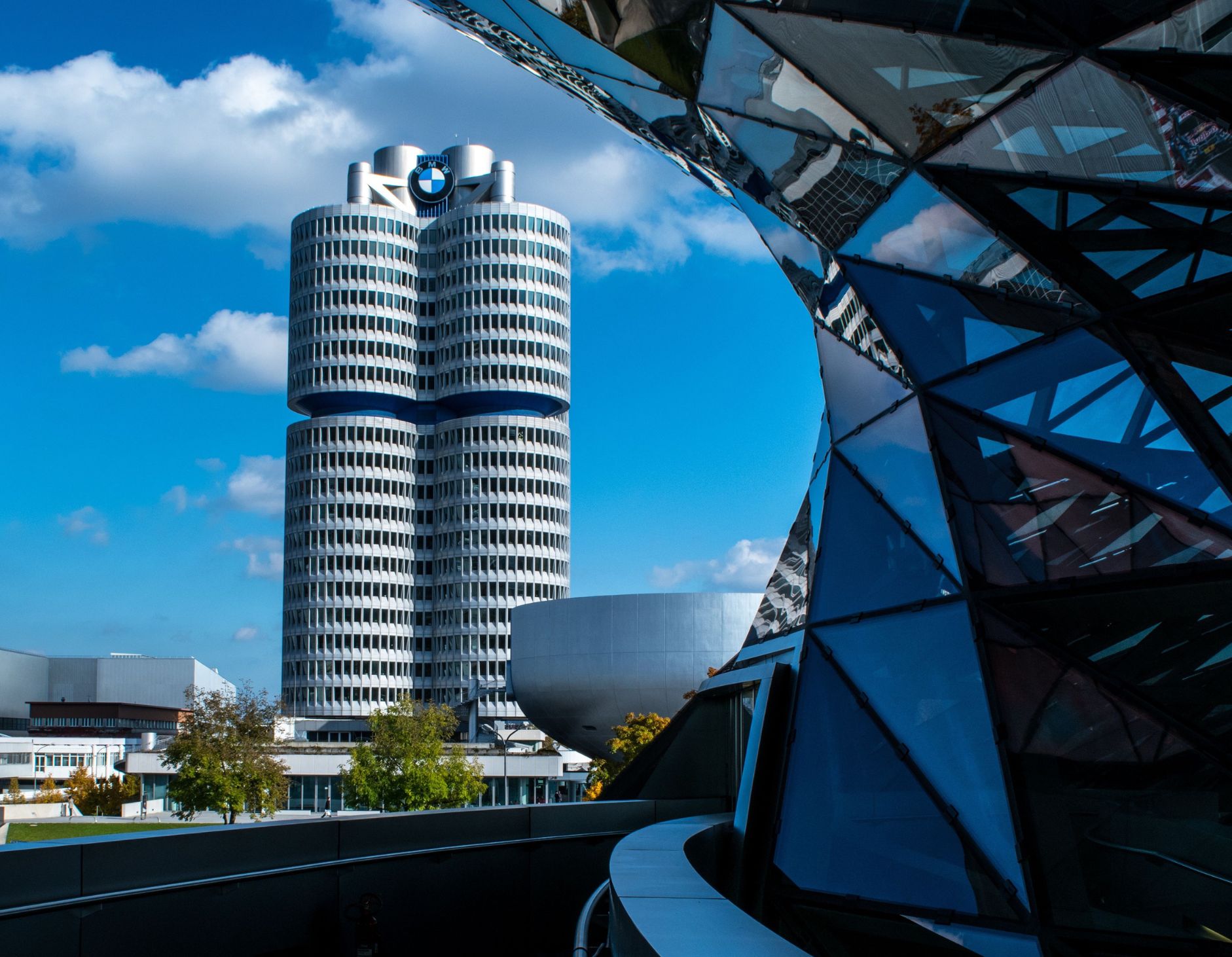
Munich is one of Europe's strongest economic regions, making it an ideal place to not just study international management, but to experience it in practice from day one. Corporate headquarters such as BMW, Siemens, Allianz, Munich Re and Linde are based here, alongside a large number of international mid-sized companies, consultancies and start-ups with a global outlook. This proximity to globally active companies makes it easier to secure practical projects, internships and a direct entry into international management roles, often already during your studies. Through the MBS Career Center, students also have direct contact with partner companies such as Microsoft, HypoVereinsbank, EY, Allianz and Techniker Krankenkasse, who specifically look for students with an international profile. For many internationally oriented career paths, from supply chain management to international management consulting, Munich is therefore not just a place to study, but also one of Germany's most relevant job markets.

International management is currently facing a double shift. First, geopolitical uncertainty, new tariffs, and the debate around reshoring and nearshoring are changing how companies plan their global supply chains and location strategies. Simply “going ever more global” is no longer a strategy on its own. Today's international managers need to think through scenarios for several possible geopolitical futures at once. Second, artificial intelligence is transforming the work itself: AI-powered tools now analyze global market and competitor data in real time, support translation and cross-cultural communication, and automate parts of international supply chain steering. For graduates, this means: solid management knowledge remains the foundation, but increasingly, what matters is the ability to critically evaluate AI-generated insights and make sound decisions in a volatile international environment, exactly the combination of analytical and intercultural thinking that sits at the core of the Bachelor and Master International Business.
Find out which of our two International Management Programs best suits your interests, goals, and preferred learning style. The self-assessment will give you some initial guidance.
✓ Introduction to Business Administration with 6 Different Specializations
✓ 12 Electives & an International Focus
✓ German- and English-language modules
✓ 3 years of full-time study in Munich
✓ Specialized Knowledge & Practical Skills
✓ Abroad or Internship
✓ Entirely in English
✓ Business Project and 7 Key Areas
A university’s accreditations are one of the most important indicators of the quality and recognition of its degree programs. Government agencies and renowned international accrediting organizations evaluate the academic excellence, practical focus, and adherence to international standards of universities. This ensures that your degree is highly regarded and opens many doors for you.
A variety of approaches and perspectives on the Munich Business School's degree programs.



Prof. Dr. Patricia Kraft doesn't believe you need to have everything figured out from the start. She believes in what you can become. As one of the two Academic Directors of the Bachelor program, she's interested in who you are – not who you are on paper. Watch the video to hear what she means by that.

International management deals with the planning, organization and leadership of businesses that operate across national borders. At Munich Business School, you combine core business fundamentals (accounting, marketing, HR, finance) with internationally focused content such as intercultural communication, international market entry strategies and the management of multinational companies. The program is rounded out with foreign languages, a semester abroad and practical projects with internationally active companies.
The Bachelor International Business takes six semesters plus a Bachelor's thesis (seven semesters in total, 210 ECTS). The subsequent Master International Business takes 18 months as a single degree (90 ECTS) or 24 months as a dual degree with a partner university abroad (120 ECTS). Both programs start in February and September.
For the Bachelor International Business you need a general or subject-specific higher education entrance qualification (or an equivalent); there's no numerus clausus, instead, a personal admissions interview is decisive. The Master International Business typically requires a first, business-related degree and sufficient English skills; students from a different academic background can complete a Pre-Master program first.
As a private university, Munich Business School charges tuition fees. Merit-based and need-based scholarships are available, including scholarships of up to €4,000. In addition, there are discounts if you take advantage of the early bird promotion and apply early. Current prices can be found on the respective program pages for the bachelor’s or master’s degree.
At Munich Business School, your admission is not determined by a minimum grade requirement, but rather by a personalized selection process that takes into account your motivation, language skills, and interest in international affairs.
In the Bachelor, you choose from six focus areas: Innovation Management, Supply Chain Management, Customer Relationship Management, International HR & Leadership, International Finance, and International Business Governance & Development. In the Master International Business, you select from seven concentrations, including Corporate Finance, International Marketing, Sustainable Business, Luxury Management, Global Family Business, Innovation & Digital Business and International Entrepreneurship.
In the Bachelor’s program in International Business, a full semester abroad, including an internship abroad, is firmly integrated into the curriculum in Semester 4. In the Master’s program, you can choose between a semester abroad or an internship in the third semester (depending on whether you meet the requirements). Studying abroad is optional here, but it is strongly recommended. Additionally, you can earn an additional Master’s degree by completing just one more (fourth) semester at a Munich Business School partner university.
Within the Master International Business, the 24-month dual-degree track lets you graduate with two full Master's degrees, one from Munich Business School and on from a partner university abroad.
The Bachelor provides a broad business foundation with an international focus and suits students entering directly after school. The Master builds on this, deepens strategic international management knowledge, and lets you sharpen your profile through seven concentrations. This is ideal if you already hold a degree or want to move directly into a specialist or leadership career internationally.
Graduates work as Supply Chain Managers, Business Development Managers, Controllers in international finance, Management Consultants, HR Consultants in international HR, or (International) Marketing Managers. According to current German salary analyses, entry-level salaries are around €40,000–50,000 per year, rising to €58,000–80,000 with experience, and €90,000–130,000+ in leadership roles (sources: jobvector, Gehalt.de — non-binding benchmarks for the German market).
Yes, the Bachelor's program in International Business can be taken either entirely in English or bilingually in German and English. The Master's program in International Business is taught just entirely in English.
Munich is one of Europe's strongest economic regions and home to numerous internationally active corporations such as BMW, Siemens, Allianz, Munich Re and Linde. This proximity to global companies makes it easier to secure internships, practical projects and a direct entry into international management roles, often already during your studies.
The greater Munich area offers one of Germany's strongest job markets for internationally minded business careers: alongside numerous corporate headquarters, the region is also home to many international mid-sized companies, consultancies and start-ups with a global outlook that specifically look for graduates with intercultural and language skills.
International Business and International Management overlap strongly. Both deal with the economic and organizational aspects of doing business across borders. At Munich Business School, the corresponding program is called “International Business”, but it covers exactly the topics typically searched for under “international management”, from intercultural leadership to global market entry strategies.
Yes. Munich Business School is state-recognized, accredited by the Wissenschaftsrat (German Science and Humanities Council) and FIBAA, and a member of the Akkreditierungsrat (German Accreditation Council). Munich Business School also holds the internationally renowned AACSB accreditation, held by only around 6% of business schools worldwide.
Yes, switching fields is possible. If your first degree wasn't business-related, Munich Business School typically recommends a Pre-Master program to build the missing business fundamentals before starting the Master International Business.

Elsenheimerstraße 61
80687 München Germany