

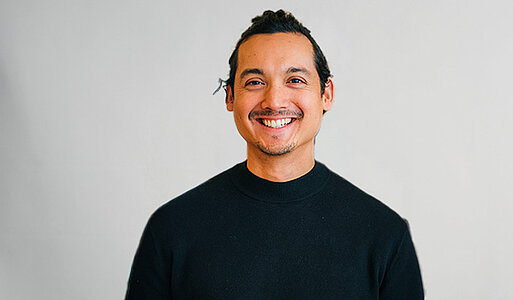
Sebastian Planck studied English and American Literary Studies as well as Philosophy at Ludwig Maximilian University of Munich and University College Cork. He completed his doctorate at LMU and the University of Alberta, focusing on processes of transformation and agency in American literature.
After completing his PhD, he founded the non-profit organization wolkenschlösser e.V., which taught language to refugees in a playful and accessible way. At the same time, he worked at a sustainability agency, where he was responsible for communication, press and public relations, as well as campaigns that helped bring climate protection and sustainable mobility into the mainstream.
At the Social Entrepreneurship Akademie—a cooperation between LMU, TUM, and Munich University of Applied Sciences—he served for 3.5 years as Head of Qualification, overseeing all educational formats related to social entrepreneurship and social innovation. In this role, he designed new teaching formats such as hackathons, sprints, and massive open online courses (MOOCs).
As Managing Director of MUC.DAI, the first study faculty of Munich University of Applied Sciences, he built up the organization, team, and network of corporate partners.
For 3.5 years, he led the Entrepreneurship Research department at the Strascheg Center for Entrepreneurship. In addition to acquiring third-party funding, he developed the research strategy in the areas of responsible entrepreneurship, ecosystems, and entrepreneurship education. His research interests span entrepreneurship education, responsible entrepreneurship, and futures studies. In 2025, he served as Scientific Chair of the 3E Conference in Munich.
He has been teaching since 2010 across various disciplines, with a particular passion for working at the intersection of sustainability, innovation, and entrepreneurship.
Professor of Innovation & Entrepreneurship
Master's in Innovation & Entrepreneurship
Planck, S. (2026). Fear and falling in love with the future: Field notes from a time-travelling educator. Tidsskrift for Social Innovation & Transformativ Entreprenørskabsdidaktik (SITE), 2(1), 8–15. https://tidsskrift.dk/site/article/view/161308
Henry, C., Mansilla, E. B., Singer, S., Gabriel, B., Valente, R., Moberg, K., Tomasi, S., Planck, S., & Sailer, K. (2025). Creating novel, responsible, and impactful entrepreneurship education models. Triple Helix, 11(3), 412–442. https://doi.org/10.1163/21971927-bja10054
Planck, S., Wilhelm, S., Kobilke, J., & Sailer, K. (2024). Greater than the sum of its parts: Combining entrepreneurial and sustainable competencies in entrepreneurship education. Sustainability, 16(9), 3725. https://doi.org/10.3390/su16093725
Planck, S., Wilhelm, S., Vogel, C., & Schlieker, A. (2024). Social Entrepreneurship und Systemwandel: Die systematische Erkundung eines Schattendaseins. In P. Kenel, J. Eschweiler, H. Hackenberg, & M. Wihlenda (Eds.), Social Entrepreneurship in Deutschland: Handbuch für Wissenschaft und Praxis (pp. 93–113). transcript Verlag. https://doi.org/10.36198/9783838563336
Sailer, K., Notz, K., & Planck, S. (2021). Social entrepreneurship. In Staatslexikon: Recht – Wirtschaft – Gesellschaft. Herder.
Planck, S., Ramsgaard, M. B., Baggen, Y., & Wraae, B. (in press). How many doctors does it take…? Exploring PhD students' motivation in balancing academic rigor and societal relevance in entrepreneurship research. RENT Conference Anthology.
Planck, S., & Wilhelm, S. (2024). Systems thinking in entrepreneurship education: An examination of competencies and pedagogical approaches for sustainable transformation. In B. Crnković & M. Leko Šimić (Eds.), Proceedings of the 13th International Scientific Symposium on Region, Entrepreneurship, and Development. Josip Juraj Strossmayer University of Osijek, Faculty of Economics and Business.
Schultchen, D., Stolze, A., Planck, S., & Gillig, H. (2024). Creating responsible deep tech intra- and entrepreneurs. In C. Henry, S. Tomasi, S. Singer, A. Cavicchi, M. Bucaille, E. Mass Lovgren, & S. Stilling (Eds.), Promoting inclusive and sustainable entrepreneurship and innovation in deep tech: A good practice guide (pp. 20–29). Start for Future.
Planck, S. (2026). Die Apokalypse als Lernraum. In FutureSEE Netzwerk (Ed.), FutureSEE Playbook: Eine kollaborative Sammlung für Social Entrepreneurship Education im deutschsprachigen Raum: 45 Use Cases von über 50 Lehrenden (pp. 137–138). Hochschule für nachhaltige Entwicklung Eberswalde (HNEE). https://doi.org/10.57741/opus4-1124
Planck, S. (in press). Case study: Regenerative entrepreneurship generation forest. Beyond Sustainability.
Planck, S. (2026, June 10). Fear and falling in love with the future: How to teach and research in the future [Presentation]. Xchange@Lunch, Munich Business School, Munich, Germany.

Elsenheimerstraße 61
80687 München Germany