MBS offers both Master and MBA students a huge network of alumni with whom they can establish contacts and thus create new prospects for the future.


A Master's or MBA degree is a great educational investment that can significantly broaden career prospects. Both degrees are equivalent postgraduate study options, meaning that they are second-degree university programs usually located after a bachelor's undergraduate degree. However, they have different emphases and goals. In this introduction, we will take a closer look at the differences and advantages of both study options to help prospective students make a decision.

A master's degree program is an advanced academic program usually offered after completion of an undergraduate bachelor's degree. It is a consecutive program, which means that it directly follows the Bachelor's Program and can also be taken directly after. However, this is not a must. A Master's program can also be started years after the Bachelor's degree.
A master's program allows students to further deepen and specialize their knowledge and skills in a specific field or discipline.
Master's degree programs are an important level of academic education and provide the opportunity to specialize in a particular field, enhance professional qualifications, and increase career opportunities. That's why master's alumni are often called specialists in their field.
Depending on the course of study and the area of specialization, upon graduation one receives the title of Master of Science, Master of Arts, Master of Law, etc., depending on the course of study that one has taken.
A Master of Business Administration (MBA) is a postgraduate degree in business administration that focuses on developing leaders and professionals in the business world. The MBA program provides a broad and in-depth apprenticeship in various business disciplines and prepares students to become effective managers, entrepreneurs, and leaders. That's why alumni of the MBA are often called generalists.
The MBA is a prestigious degree that is recognized in many industries and internationally. Many individuals pursue an MBA to improve their career opportunities, advance to leadership positions, start their own business, or change careers.
However, an MBA program requires more than a bachelor's degree or its equivalent and the corresponding good grades, as a master's degree program requires. MBA programs are aimed at people with professional experience, which must be proven. Depending on the university, different lengths are required, but a good guideline is about 2 years.
The MBA is also suitable for professionals who have not studied business administration in their bachelor's degree. For example, physicians, engineers and scientists can also build up a solid knowledge of Business Studies and advance to a management position.
A Master's degree and an MBA (Master of Business Administration) are two different types of postgraduate programs with different focuses and goals. Here are the main differences between a Master's and an MBA:
In summary, a master's degree focuses on deepening expertise in a particular field, while an MBA focuses on developing management and leadership skills in the business world. The choice between a master's and an MBA depends on individual career goals and interests.
The decision to pursue a master's should be well thought out and dependent on your personal and professional goals. Here are some factors and considerations that can help you decide when it makes sense to consider a master's:
The decision to pursue a Master of Business Administration (MBA) should be carefully considered and depends on your individual career goals and circumstances. Here are some factors and considerations that can help you decide when it makes sense to consider an MBA:
| Criteria | Master | MBA |
| Age | Mostly early 20s | Mostly early 30s |
| Cost | Mostly a little cheaper | Mostly a little more expensive |
| When | After Bachelor directly or also later | After Bachelor & work experience (mostly 2 years) |
| How long | 1-2 years | 1-2 years |
| Requirements | Bachelor or comparable degree, often certain grade point average | Bachelor or comparable degree, often certain grade point average, work experience |
| What is offered | Specialization | General broad knowledge |
| Specialization | General broad knowledge | General business and management topics |
| Field of specialization | Almost all subjects that offer a Bachelor's degree usually also have a Master's degree | Business Administration - Business Studies & Management |
| Professional goals | Experts or researchers | Executives and managers |
| Teaching methods | Theoretical knowledge, practice-oriented elements possible | Case studies, projects and teamwork etc. |
| Practical orientation | Mostly little | Emphasizes practical application |
| Degree | Master of Arts, Science, Laws etc. | Master of Business Administration |
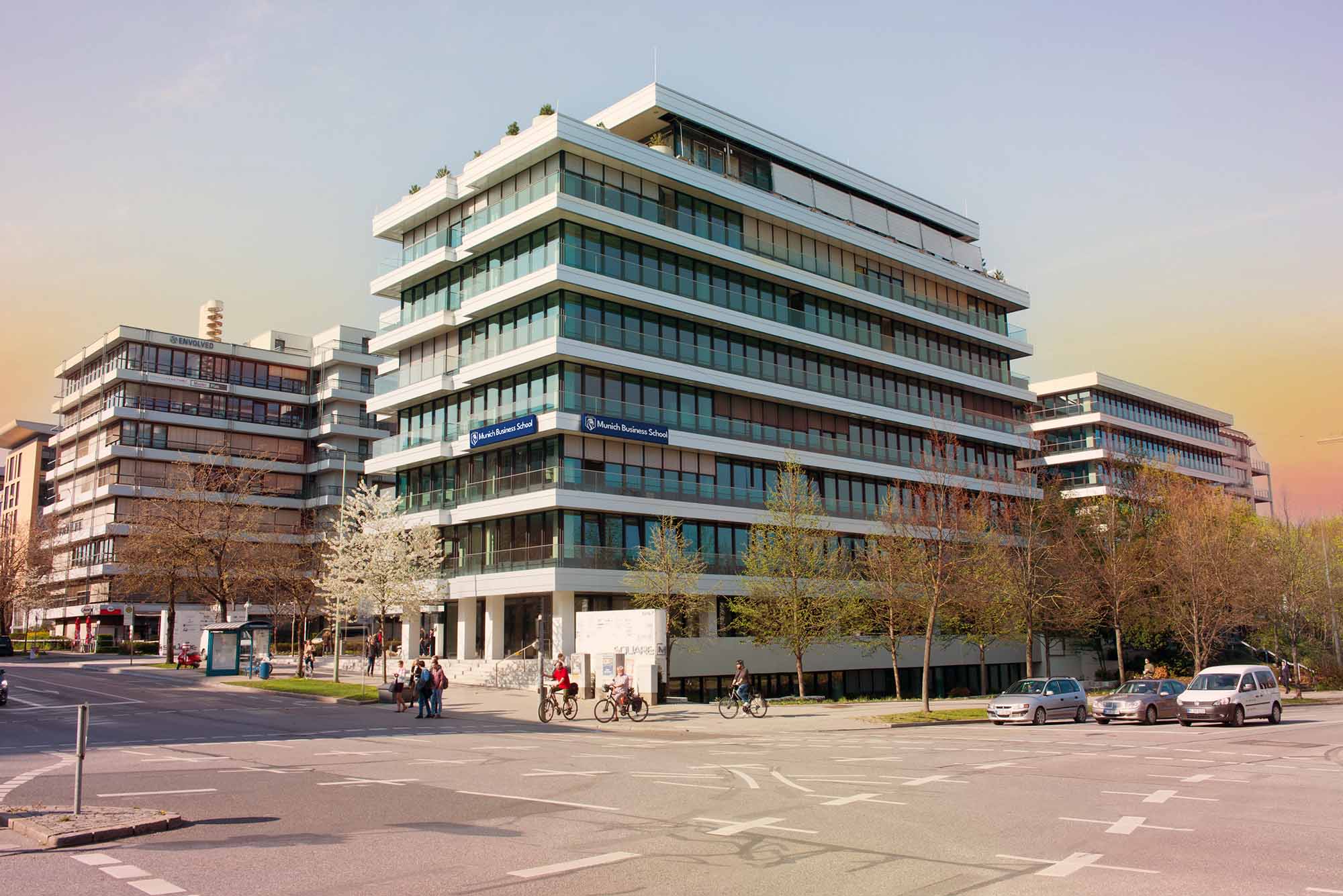
Munich Business School stands out thanks to its international focus. Its degree programs are designed to prepare graduates for global markets and provide them with a solid understanding of international business realities. Behind this is a faculty of experienced professionals from all over the world who offer practical insights into relevant trends.
Practical experience plays a major role in general. The programs consistently combine theory with real-world applications through case studies, projects, and internships at international companies. This is complemented by a broad network of partner universities, which enables exchange semesters and additional experience abroad.

The career opportunities are correspondingly diverse. A master's degree in international business opens doors to multinational corporations, international organizations, export companies, chambers of commerce, and other areas. At the same time, students automatically improve their language skills, as many programs are conducted in English and additional foreign languages are integrated.
The MBS network provides access to fellow students, alumni, and corporate contacts—ideal for establishing relevant connections early on. The Munich location enhances the overall package: high quality of life, strong economy, good career prospects.
International accreditations underscore the quality of the degree. In addition, flexible specializations allow students to clearly align their focus with their personal interests and career goals.
The master's programs at Munich Business School offer high-quality education with a focus on internationality and practical relevance. Students benefit from individual focus, interactive teaching methods and a close connection to the business world. The opportunity to build a global network and live in the attractive city of Munich round out the benefits. These programs prepare students for successful careers in various business areas. Munich Business School offers a selection of top-notch master's programs to take your education to the next level:
This degree program not only deepens your business knowledge, but also gives you the opportunity to further your education in various focus areas. These include Innovation and Digital Business, Sustainable Business, International Marketing, Luxury Management, Corporate Finance Global Family Business and Wealth Management and International Entrepreneurship.
If you dream of creating your own start-up or already have a promising idea, this master's offers the perfect foundation to develop your entrepreneurial skills. You will acquire advanced business skills and learn to manage, identify and implement innovations in order to operate successfully in an international environment.
This program provides you with expertise in behavioral psychology, innovation, consumer behavior and brand communication. You will also gain tools and skills to analyze market structures and competitive environments.
If you love sports and at the same time have an interest in the background of the sports sector, this master's offers the perfect combination. The course content includes sports communication and media, sports sponsorship and marketing, licensing and rights exploitation, as well as digital sports management and sports event management. After graduation, you can work as a specialist in companies in the sports industry, sports clubs and associations.
This degree program focuses on the world of business and finance. Strategic management and finance are the focus. Upon completion of the program, you will have extensive knowledge in financial management, financial statement analysis, mergers and acquisitions, risk management, capital markets and much more.
The MBA program at Munich Business School offers high-quality management education tailored to the needs of executives and entrepreneurs.
The MBA program at Munich Business School offers high-quality management education tailored to the needs of executives and entrepreneurs. The advantages of this degree program include practical teaching content, networking opportunities, an international focus, and its location in Munich, a city with a high quality of life. Graduates benefit from enhanced career opportunities in management positions and business start-ups, as well as the chance to build a global professional network. Munich Business School enjoys an excellent academic reputation and is internationally recognized.
The choice between an MBA and a Master's depends on individual career goals and interests. An MBA is more appropriate if you want to pursue a leadership position in the business world or be entrepreneurial. A master's is better suited if you want to focus on a specific field or academic career. It is important to consider your goals and the requirements of your intended career to make the right decision.
An Executive MBA (EMBA) is a specialized MBA degree designed for experienced professionals and managers. It is designed to provide working professionals with the opportunity to improve their management skills and leadership abilities without having to give up their professional commitments. The EMBA often includes challenging courses and emphasizes the application of business strategies to the real world. This degree allows executives to advance their professional development without interrupting their careers.
The value of a master's or MBA degree depends on your career goals and the industry you want to work in. Both degrees have their own value. A master's is valuable if you want specialized expertise and an academic career, while an MBA is valuable if you want a leadership position in business or management. Ultimately, the value depends on how well the degree fits your individual goals.
An MBA title stands for "Master of Business Administration". It is a postgraduate academic degree designed to develop managers and professionals in the business world. The title is awarded upon completion of an MBA program and attests to successful completion of a comprehensive management and business administration program.
A Master of Business Administration (MBA) offers a wide range of benefits, including:
The exact benefits depend on individual goals and career situation. However, an MBA can be a valuable investment in professional development.








Elsenheimerstraße 61
80687 München Germany