An international seal of quality awarded to only 6% of business schools worldwide. It attests to high quality and enhances the recognition of the degree abroad.


“Business Administration” is the term commonly used internationally for what is also known as a degree in business studies. At Munich Business School, you can study it entirely in English, with a semester abroad, hands-on projects, and a network spanning more than 100 nationalities, right in the heart of Munich, Germany.

At Munich Business School, there isn't just "one business administration program"; rather, there are two distinctly different programs designed for different starting points and career goals.
MBS's foundational Business Administration Bachelor's degree covers all classic core disciplines of business: finance, marketing, HR, logistics. And is taught entirely in English in the English Track, alongside students from all over the world.
The consecutive Master's degree builds on a first business-related qualification and deepens Business Administration through seven international specializations to choose from, from Corporate Finance to International Entrepreneurship.
All course content at a glance: module by module, semester by semester, topic by topic.
6 Semesters · 210 ECTS · B.A. · German & English · Start: February & September
3 Semesters (Single Degree) · 4 Semesters (Dual Degree) · M.A. · English · Start: February & September
One of Germany's most international and economically strongest locations as your place of study.
A quality seal recognized by employers and universities worldwide, only 6% of business schools worldwide hold it.
Small cohorts with personalized guidance from instructors with practical experience.
Business partners and career partners such as Allianz, Lufthansa, Daimler, UniCredit, Siemens, Microsoft, etc.
A resource for internships and career entry, featuring regular events with companies.
Dual-degree programs are available through partner universities worldwide, such as the Master's in International Business.
Business administration is considered a versatile but also highly competitive field. The following figures are based on current salary data (2026) in Germany.
| Career stage | Annual salary (gross, nationwide Germany) |
| Entry-level (Bachelor's) | €43,450 |
| With an international Master's degree | typically over €60,000 (MBS alumni figure) |
| Professional with several years of international experience | €57,200–75,700 |
| International leadership level | €75,700+ |
Here you can learn all about some of the career opportunities available to you after completing a degree in business administration.
For an internationally oriented Business Administration degree, Munich is an ideal setting: around 30% of its 1.6 million residents have an international background, Munich Airport connects the city to roughly 230 international destinations, and eight of Bavaria's eleven DAX-listed corporations, including names like Allianz, Siemens, BMW, and Munich Re, are headquartered here or run key international business functions from the city. With a purchasing power of €38,364 per capita (35% above the German average) and 43.1% of the workforce holding an academic degree, the region offers an environment where international careers can be built right on your campus's doorstep. No detour through a year abroad after graduation required.
Sources: Munich Business Development Agency, location facts 2025/26 (munich-business.eu); City of Munich
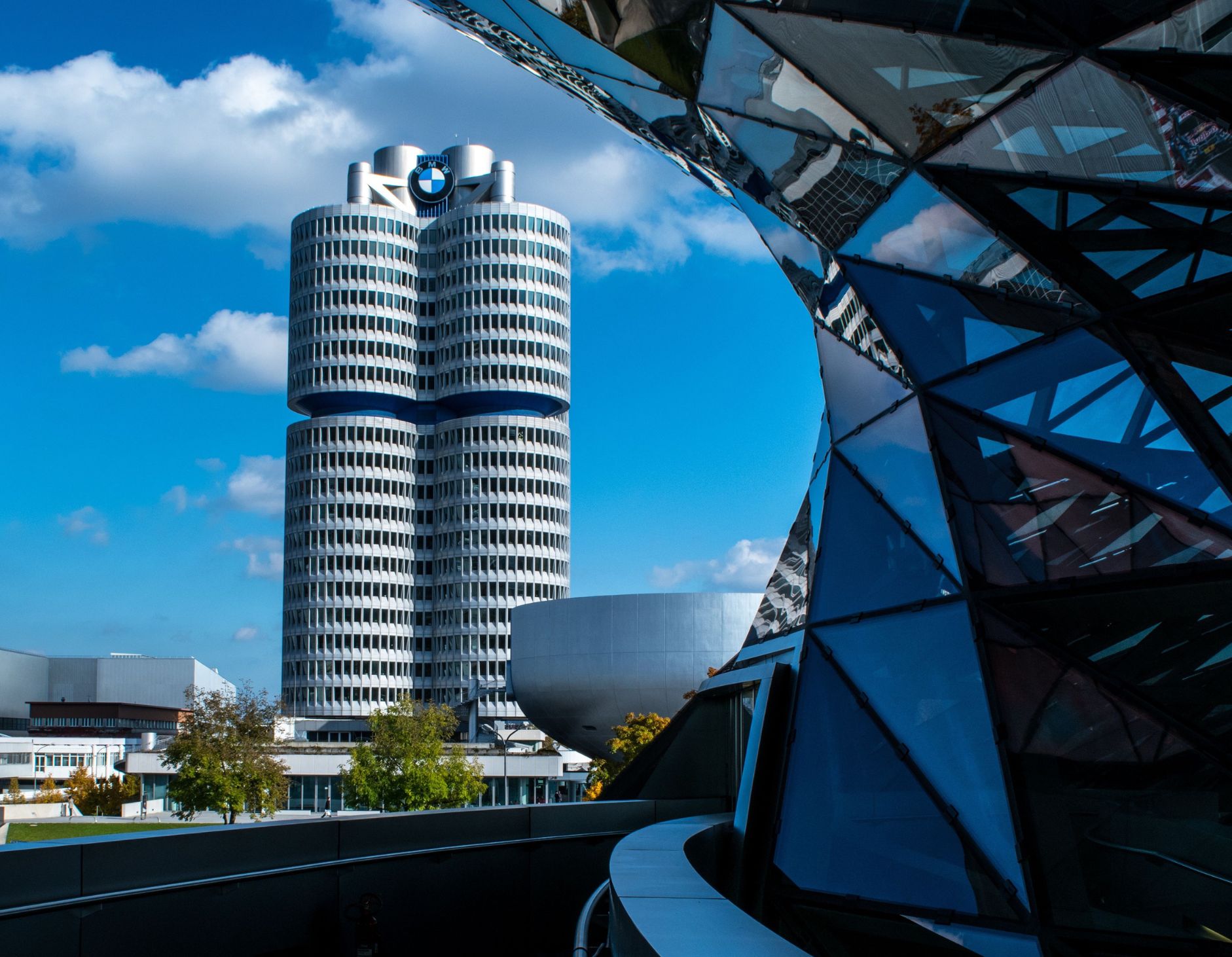

AI tools are increasingly automating reporting, market analysis, and translation work, tasks that used to be part of classic international management roles. At the same time, geopolitical uncertainty and the complexity of global supply chains keep growing, so companies need talent who can confidently use AI-powered tools and navigate the cultural, legal, and economic differences between markets. This is exactly where an internationally oriented Business Administration degree comes in: specializations such as Innovation & Digital Business or Sustainable Business within the Master International Business are designed to prepare you for precisely this dual requirement, digitally savvy and globally competent.
Find out which of our two business administration programs best suits your interests, goals, and preferred learning style. The self-assessment will give you some initial guidance.
✓ Foundations of Business Administration with Various Specializations
✓ Elective Courses & International Focus
✓ German- and English-language modules
✓ 3 years of full-time study in Munich
✓ Specialized Knowledge & Practical Skills
✓ Abroad or Internship
✓ 100 % English
✓ Business Project
A university’s accreditations are one of the most important indicators of the quality and recognition of its degree programs. Government agencies and renowned international accrediting organizations evaluate the academic excellence, practical focus, and adherence to international standards of universities. This ensures that your degree is highly regarded and opens many doors for you.
A variety of approaches and perspectives on the business degree programs at Munich Business School.



Prof. Dr. Thomas Röhm and Prof. Dr. Christian Schmidkonz believe that learning is about more than acquiring knowledge. In the Master in International Business, it's about taking on responsibility, connecting the dots across disciplines – and working alongside people from all over the world. What that means for your development, they explain in the video.
“Business Administration” is the internationally used, typically English-language term for what's known as BWL (Betriebswirtschaftslehre) in German-speaking countries. The content barely differs; the English name mainly signals an international or English-taught orientation, which is exactly what Munich Business School delivers.
The two overlap heavily. At Munich Business School, the undergraduate degree is officially called the “Bachelor International Business” and covers classic Business Administration content, with an added international focus including a semester abroad and a choice of world regions to specialize in.
A BBA typically leans even more toward hands-on management skills, while a Bachelor of Arts (B.A.), the degree Munich Business School awards, also integrates broader business and interdisciplinary content. In practice, employers recognize both degrees comparably.
Yes. The entire Master and Bachelor degree is taught in English. For the Bachelor a bilingual track (German/English, roughly 70/30) is also available.
To enroll in the Bachelor’s program in International Business at Munich Business School, you need a high school diploma (Abitur, Fachabitur, IB Diploma, or equivalent) and English proficiency at least at the B2 level. For the Master’s program in International Business, a bachelor’s degree in economics or a comparable field is also required.
The Bachelor International Business takes 6 semesters plus one additional semester for the internship and thesis. The Master International Business takes 3 semesters as a single degree or 4 semesters as a dual degree.
As a private university, Munich Business School charges tuition; discounts of 10–50% are available for the first two semesters. Current tuition rates and scholarship terms can be found on the corresponding scholarships and financial aid page.
Unlike many dual or part-time programs, the Munich Business School program is a full-time program featuring integrated but clearly defined practical phases, a mandatory semester abroad, and a consistently international learning environment.
Yes. Munich Business School is AACSB-accredited, a seal held by only around 6% of business schools worldwide, as well as FIBAA-accredited and state-recognized, supporting the international recognition of its degrees.
Typical fields include international business development, business analysis, change management, operations management, international account management, and brand management, anywhere cross-border business thinking is in demand.
Entry-level salaries with a Bachelor's degree average around €43,450 gross/year nationwide in Germany. Munich Business School alumni with a further international Master's degree often report starting salaries above €60,000, depending on industry, region, and individual experience.
Yes, graduates of the Bachelor International Business can progress into the Master International Business without a separate application process and choose one of seven specializations there.
47% of Bachelor's students come from abroad, there are more than 70 partner universities worldwide, a fixed semester abroad, and six selectable international focus areas including foreign-language courses.
Anyone who wants to study internationally and in English from day one, for example, with a career goal in international companies, globally oriented corporations, or their own international ventures.
Sustainable Business, International Marketing, Corporate Finance, Luxury Management, Global Family Business, Innovation & Digital Business, and International Entrepreneurship. Two selectable per semester.
With around 30% of residents having an international background, an airport connecting to roughly 230 international destinations, and eight of Bavaria's eleven DAX-listed corporations based here, Munich is one of Germany's most international and economically strongest locations. This is ideal for building an international career right where you study.

Elsenheimerstraße 61
80687 München Germany